My social-media utterances this year, in all their political-anxiety and quixotically-attempting-to-engage-with-the-other-side glory. Leavened by not nearly enough comic relief.
-
“Time to make the donuts” is my first waking thought most days.
-
Visited Kachka recently, and ate “like a Russian” as advised by the menu: with every square inch of the table covered in assorted zakuski and pelmeni, interspersing tastes of everything with shots of three different kinds of vodka. It was amazing. And all I could think of was how much I missed out in the 1980’s, before I knew how to eat, when I politely declined all the unfamiliar Russian dishes Olga Epelboim put in front of me when I visited. I’m sure now that they must have been delicious.
-
Webcomics make the best essays. The Good War
-
[In a comment thread.]
Animal House, in case you didn’t know, is the greatest comedy ever made, with the possible exceptions of Groundhog Day, Scott Pilgrim vs. The World, and What’s Up, Doc?
-
[Commenting on (and quoting) a post promoting a right-wing opinion column.]
“if you read with an open non biased mind (sorry most wont)”
O the irony.
-
Everyone is wrong. What’s your position on GPS?
-
Earlier today I was despairing. “How does the rule of law come back from a day like today?”
Then I read @HoarseWisperer’s tweet and I thought, “Oh, maybe this way.”
-
[After the State of the Union address.]
The best thing you can do today is to donate money to an organization to repudiate the destructive agenda described in last night’s speech. Does it bother you that Trump and his allies are dismantling individual liberties? Donate to the ACLU. That they’re trashing the environment? Donate to the Sierra Club. That they’re enabling hate groups? Donate to the Southern Poverty Law Center. That they’re co-opting the news media? Donate to ProPublica. That they’re undermining the very structures of government? Donate to Indivisible, Flippable, or SisterDistrict (and vote in November!) to elect officials who respect rather than revile the role of government.
There are a hundred other worthy organizations you could send money to. Choose one, choose two, choose ten. But donate a meaningful amount TODAY – NOW – to help us all send the message loud and clear that we reject the plutocracy the GOP cheered for last night – we want Liberty, we want Justice, and we want them for All.
Let tomorrow’s headlines be about the outpouring of opposition to Donald Trump and his shameless enablers.
-
[Commented on a post by Dave, a right-wing friend, condemning kneeling during the national anthem, on the grounds that it’s disrespectful to the armed forces.]
Suppose a white man shoots a young black kid to death and gets away with it by telling a jury nothing more than “a black kid in a hoodie made me afraid for my safety.”
Suppose a cop gets away with basically the same exact thing.
Suppose that happens again and again and again and again. Suppose it happens hundreds and hundreds of times in places all over the country and there’s no sign of things ever changing for the better.
Suppose the collective apathy about this crisis offends your conscience. And suppose you’re a celebrity. You’d like to use your renown to give something back to the country that made you a star. You don’t want to make too big a thing out of it – no speeches, no marches, no boycotts – just a quiet symbolic gesture in the hope that it will raise awareness.
What would you do?
[Friend responded that I can’t keep up this “insane liberal rage” for seven more years.]
Not rage. A sincere question. What would you do?
I’m curious. Why did this read to you as “insane rage”?
[And when Chris chimed in with, “Don’t try to have an intelligent conversation with a liberal. It just won’t work.”]
That can be taken either way. Not knowing you, it’s impossible to tell who you’re insulting, me or Dave!
[And when the thread went silent.]
I posed a simple question above: “What would you do?”
I didn’t get an answer. But I did get called a liberal, twice.
What about my question makes me a liberal? My question barely expresses any opinions; it just lays out a hypothetical (a thinly veiled one, I admit). If there’s any opinion that comes through, it’s a hatred of injustice.
But that’s universal. Don’t you hate injustice too?
[And finally…]
So rather than get an answer I got called a liberal, as if that excuses conservatives from engaging with me.
But we are countrymen together. Neither of us is going away. It is our civic obligation to engage with one another. To compromise. America has at times been excellent at this – and those are the times America has been best.
What’s the alternative? Constantly to undermine one another? Whose agenda does that serve?
The truth is, liberals and conservatives agree on most things. We all want safe food and drugs, clean air and water, adequate pay for honest work, fair elections, peace, justice, public safety.
But no politician ever won office by telling you how much they’re like their opponent. So they must find the fissures of disagreement, drive a wedge there, and hammer, hammer, hammer. If they do it enough you can start to believe that your political opponents – your fellow Americans! – are traitorous threats to your very way of life. Don’t fall for it.
They have to keep us hating each other to keep the money and the votes flowing. But it’s not liberals vs. conservatives. It’s all of us against the fuckers that want to keep us divided.
-
Gotta become a billionaire now so I can mount a vanity space mission to recover Elon’s Tesla.
Glad finally to have a reason.
-
TFW a complex narrative dream draws to a satisfying conclusion and you wake up naturally five minutes before the time you had the alarm set for.
-
[In reply to @TomiLahren’s tweet, “Can the Left let the families grieve for even 24 hours before they push their anti-gun and anti-gunowner agenda?”]
Is it time to talk about last week’s massacre yet?
The one the week before that?
The one the week before that?
The one the week before that?
-
[Replying to a gun-rights maximalist in a comment thread after another mass shooting.]
“semi automatic weapons were around for decades before these Mass shootings became so common”
My pet theory: we are collectively too wealthy. Our homes have gotten too big and comfortable. We therefore spend too much time in them and too little in common spaces, disintegrating our communities.
Whether that’s true or not, positively identifying deep societal problems won’t happen any time soon, to say nothing of fixing them. In the meantime, the next gun massacre will happen soon. This is an emergency. I suggest sensible gun-control measures. What practical solution do you suggest? It should be something other than “get people wondering whether guns are the real problem.”
-
[In another comment thread about how to address the problem of school shootings.]
There are over 90,000 schools in the country. Stationing a single $30k-per-year rent-a-cop at each one of them will cost $2.7 billion and offhand doesn’t seem like it will accomplish very much. Even if that money were available I’m sure many of those schools would prefer to spend it on more teachers, new textbooks, heat in the winter, etc.
-
[Mueller indicts Russian spies with ties to the President; Congressman Nadler mentions possibility of impeachment; right-wing friend says Nadler should get voted out.]
Have you read this week’s Mueller indictment? It’s here: https://www.justice.gov/file/1035477/download
If you “can’t believe” what Nadler’s talking about, then you have to be prepared to refute the numerous specific, credible allegations in that document laying out the means and motives for a concerted and ongoing criminal conspiracy by foreign nationals to disrupt our electoral process and other civic functions.
Or you have to believe that protecting against that kind of threat isn’t required of the President. In which case, have you read his job description? It’s here: http://constitution.findlaw.com/article2.html
[Another in the thread writes, “Democrats are not only Stupid, they are IDIOTARDS!”]
If that’s your attitude, how do you propose to make common cause with them? We are, after all, one nation, and Democrats comprise very many of your countrymen.
If we can’t focus on the things that unite us, governing by compromise and concession like every generation for 150 years has managed to do, we’ll descend into endless squabbling at least, and perhaps even tear ourselves apart – either of which outcome benefits other major players on the world stage.
Don’t follow their script.
[Still another, Gregg, asks, “What does Nadler want POTUS to do declare war on Russia?”]
There are many, many steps that can be taken before war. Sanctions. Freezing of assets. Dedicating the resources to strengthen those institutions that are under attack. Making a damn speech.
A great start would be to stop trying to undermine the investigation that’s uncovering all this.
[Gregg responds that Japan attacked Pearl Harbor because of sanctions.]
Are you arguing that, because it led to the attack on Pearl Harbor, we should not have organized the global embargo of Japan? Even after it had invaded China and attacked American, British, and Dutch interests (to say nothing of their brutality towards the Chinese)? Even when their expansionist plans were clear, and threatened our allies? What should we have done – nothing?
In the eighty years since then, sanctions, freezing of assets, expulsions of ambassadors, punitive tariffs, and other common tools of diplomatic pressure have been used innumerable times all around the world, hardly ever leading to war.
What should we do now? Not declare war, but not do anything that might provoke a hostile response – so, nothing?
-
[Comment thread with gun-rights maximalist Derick, asking what if you need to defend against home invasion.]
If I were seriously afraid of that possibility, my first step would be putting steel bars on all my windows, and reinforcing my front door – measures that might reduce my home’s curb appeal but at least don’t require extending dangerous rights to murderous maniacs. The fact that many people claiming to need assault weapons for home defense don’t take other simpler measures first suggests to me that there’s something else going on.
[Derick asks, what if it happens anyway? What would you do?]
What would I do? Comply with their demands and hope for the best. Anything else is a Hollywood fantasy.
My gun would of course be locked in a gun safe, and my ammunition would be locked away separately – basics of responsible gun ownership. Most of the ways a home invasion scenario could unfold would not permit me to get my weapon and the ammunition for it and load it and be ready to use it. Plus I’d have to believe in the first place that that’s the best way to survive the situation. The situations in which I believed that and could get and load my gun AND couldn’t get the job done except with a military assault rifle are fewer still.
Why obsess over this scenario? You take a bigger risk going outside without sunscreen.
[Why he obsesses: it happened to his young daughters.]
That’s a horrifying story. I’m glad it turned out OK […]
However, nothing in your story suggests that the acquisition of murder-spree quantities of munitions by mentally unbalanced teens must remain completely frictionless.
-
[Friend asks what to do when confronted with an idiotic proposal like arming teachers: dignify with a response, or ignore and cede the debate?]
“What to do?”
This: @profmusgrave’s tweet
Don’t tell people they’re idiots. They won’t hear you. Ask questions that expose their idiocy.
-
[After another mass shooting.]
Of course it’s violent videogames, it’s gotta be. Unless there are any counterexamples, like countries that have violent videogames and no mass-shooting epidemic. 🤔
-
[Regarding the outspoken survivors of the school shooting in Parkland, Florida.]
Why are kids having success speaking truth to power when the rest of us have not for so long? Not because they are recently traumatized. It’s because Fox hasn’t spent decades laying the groundwork for how to ignore and belittle them.
-
I’ve been telling my kids, “My generation is leaving a mess yours is going to have to clean up.” AND IT’S HAPPENING. 😍 @LittleMissFlint’s tweet
-
The NRA changed from being about shooting targets and food to shooting people. RAWR
-
I refuse to buy anything in the “For Dummies” line of products and so should you.
-
The French Lieutenant’s Woman is streaming on Amazon Prime. It’s an unusual movie in which Meryl Streep and Jeremy Irons play dual roles: lovers in 19th-century England, and the actors portraying those lovers in the film-within-a-film being shot in the modern day. Period scenes are intercut with modern scenes; the two stories parallel each other.
I cannot stop thinking about a scene in which the actors are rehearsing a moment in the film. It’s the simplest little moment: he sees her, she sees him. They start to run through it but are casual and unfocused. They are actors, acting. They perform it something like I imagine I would (my acting skills never having developed beyond the sixth grade). Then she says, “let’s just do it again” and they do. An alchemical transformation takes place. Suddenly they are in the scene, they are their characters. Even though it’s the same two people in the same little room on the same dreary afternoon, somehow, all at once, it’s not – and that’s before the scene abruptly jumps back to the 19th century. It is pure magic, and it proves the adage that good acting is the best special effect. The French Lieutenant’s Woman Clip – Scene Rehearsal
-
[Right-wing friend lauds Trump for meeting with North Korean leader Kim Jong Un.]
North Korea has sought a meeting with an American president since the 1990s. That Trump chooses to engage now signals to every other third world dictator that their best bet is to develop a nuclear program too.
-
Signing into any website and clicking the Remember Me checkbox now triggers a big Mexican musical number in my head. #Coco
-
We choose to go to the moon, not because it is easy, but because we need a Space Force. #iftrumpsaidit
-
December 7th, 1941, a famous, very very famous date. #iftrumpsaidit
-
Fuck. If this is true, the moment of truth is fast approaching when we must all stand and fight, maybe literally, in a showdown between democracy and totalitarianism. @BillKristol’s tweet
-
Mr. Gorbachev, build this wall! #iftrumpsaidit
-
Speak softly and carry – I’m the softest speaker, OK? The. Softest. No one speaks softer than me. And I do, I carry a big stick. A serious, serious stick. #iftrumpsaidit
-
The only thing we have to fear is rapists from Mexico. #iftrumpsaidit
-
Ask not what your country can do for you. I’ll tell you what your country can do for you. Not much, I can tell you that. #iftrumpsaidit
-
[Friend reports his kid found a VHS tape and had no idea what it was. They couldn’t watch the tape, but found an online version to watch.]
When you’re done streaming, remember: be kind, rewind
-
[On high school classmate Cynthia Nixon running for governor.]
I have been hearing Edward Everett Horton announce in disbelief “The Governor of New York State!” all day long. Pocketful of Miracles clip
-
Really, really pleased to be able to share the past several months’ work by the thoughtful and talented team at Chain: TxVM, the transaction virtual machine. Introducing TxVM, the Transaction Virtual Machine
-
 Hey, wait a second, babies don’t lactate. Just what is Holland trying to pull?
-
McConnell doing something sensible? I am so confused. Sen. Mitch McConnell pushes bill to legalize hemp
There just has to be something corrupt behind this.
-
[Responding to a cynical post about the questionable new policy of making Parkland students wear clear backpacks and ID badges.]
“Welcome to the futility of adulthood.”
It’s just more difficult than most expect, not futile. If it were futile to try achieving things through collective action, we’d still have slavery, women wouldn’t have the vote, everyone would fear smallpox, there’d be no flag on the moon, rivers in Ohio would routinely catch fire, and we’d all have to be covered head-to-foot on sunny days because of ozone depletion.
-
@Emma4Change is not the first E.González to affect presidential politics.
-
[Friend says he has a “+5 dog of cuddling.”]
The dragon attacks! You say, “Fluffy, cuddle!” Fluffy nuzzles the dragon. They curl up together. You loot the gold.
-
Dear Jeff Bezos, George Soros, or whoever: please buy a controlling interest in Sinclair Broadcast Group. A steal at $1.6 billion. Thanks!
-
[In a thread about the evils of social media.]
Social media has its problems, no doubt about that. But without it, how many of you would I be in touch with? How many of my ideas could I get across, and how many of yours could I absorb? Would politicians feel compelled to pay attention to the Parkland kids? Could we go back to relying solely on the mainstream press? Could the (much diminished) mainstream press even do its job without using social-media posts as informal stringers?
The techno-utopianist in me is not dead yet. If these platforms can be made savvier, and if we can become savvier in how we use them – as earlier generations did with their brand-new forms of media – I believe they may be the very key to reversing the divisions they have sown.
-
The name of a character in my dream last night: Dr. Fishfuffy.
-
[In reply to @AoDespair’s tweet]
Because when you actually are supreme you don’t have to go around insisting you are.
-
[In reply to @iiTalW’s tweet, “People who can’t distinguish between etymology and entomology bug me in ways I cannot put into words.”]
Laughed so hard I almost needed an enterologist.
-
Welcome to America, where we don’t care what you’re famous for as long as you’re famous.
-
 [Eleven years after Mom died.]
Neil Diamond karaoke at the top of my voice. Miss you, Mom.
-
React to Trump with sputtering outrage and you’re playing on his turf. You have no chance. Stay cool, calm, confident, and classy, and he’s defenseless.
-
Dear @ATT, if you really think pay-for-play was a mistake, you’ll renounce the fruits of that deal. Otherwise, you really only think getting caught was a mistake.
-
[In reply to @jasontoff’s tweet]
Just this week my long-time dental hygienist confessed to me she’s had plenty of cavities, “same as anyone.”
-
[In another comment thread about NFL players kneeling during the national anthem.]
“I remember when I could go to a concert, a movie, or a ballgame and not deal with politics.”
People who aren’t professionals, or straight, or white, or men read that and think, “Imagine being so privileged you could ignore politics.”
-
I like the way the word “continuum” sounds and wish we pronounced “vacuum” the same way.
-
[Latin professor friend asks me to turn a comment about her cat into a haiku.]
[reporting for duty]
Snoring Percy dreams
While I write Latin exams:
“Dormiens bonum”
-
[Trump tweets, “Great meeting with Kim Kardashian today, talked about prison reform and sentencing.” Friend posts it with the comment, “I rebooted my router but I still seem to be living in some insane nonsense universe.”]
When did we fork off of the sensible timeline?
I think it was at the moment that presidential stain landed on Monica Lewinsky’s blue dress, though no one could have known at the time the power it would grant to the forces of Chaos. In the movie they’ll make someday about this era, that instant will be freighted with significance via super-slow-motion (tastefully, somehow, I hope), accompanied by a dissonant orchestral crescendo and spinny kaleidoscopic visuals to represent a Rip in Reality.
-
[Smartphone display design trends vs. slow recovery from hurricane devastation.]
I see the word “notch” in my various news feeds about ten times as often as I see “Puerto Rico.”
-
[Comment thread about science headline, “Process takes CO2 from the air, converts it to carbon nanotubes.]
Coming soon: “Desperate scientists seek ways to resuscitate plant life and reduce widespread fires after oxygen/CO2 imbalance.”
Also: “Carbon nanotube lobby disputes atmosphere imbalance is human-caused.”
-
Sitting in a Starbucks, listening to a mom who has clearly forgotten what it is to be a child trying to talk her young daughter out of a sugary snack… by describing what’s in it. “It’s marshmallow and white frosting. No.” “PLEEEEEASE.”
Child abuse.
-
[In reply to @adamdavidson’s tweet, “After showing some Trump-supporters statistics that quickly disprove their pro-Trump/anti-Obama economic claims, I have come to the following conclusion: This isn’t about facts.”]
Disagree. The facts will matter in the end. The challenge first, though, is getting those facts past the rhetorical defenses erected by the likes of Fox News.
-
Inhumane work conditions > labor unions > “Capitalism works, who needs unions?”
Racism/sexism > civil rights laws > “We are equal, who needs laws?”
Horrifying diseases > vaccines > “No epidemics, who need vaccines?”
Tyranny > democracy > “No tyrants, who needs democracy?”
#wcgw
-
Woke up this morning reluctantly realizing that I need to do the right thing and turn myself in for my recent act of theft and vandalism, if for no other reason than to spite Donald Trump by showing how one takes responsibility for one’s actions. A few weeks ago I stole an unattended new ferry boat on a lark, piloted it up one of Marin’s waterways, ran it aground in some shallows, and then hiked out of there. I’ve nervously been following news reports of the incident since then. A lot of people had been inconvenienced cleaning up after my little stunt, and I caused at least tens of thousands in property damage. I wanted to give myself up before the investigation led to me. I was probably headed for jail.
It was only after I’d been awake for several minutes that I slowly became convinced, with growing relief, that none of this had ever actually happened. Instead it’s been an interlocking series of dreams I’ve been having over the past few weeks.
Or has it? Maybe it was just one dream, with a depth-of-time illusion as one aspect of it, making it seem like I was remembering things from weeks ago when I wasn’t really. How would I know the difference?
Have you ever had a series of dreams telling a continuing story across days or weeks? Are you sure?
-
The guy who took the seat right next to me on the ferry when there were still plenty of others available, and who I therefore automatically resented even though the ferry was bound to fill up anyway, just gave up his seat to a young mom standing with babe in arms, so now I have to admire him, dammit.
-
[Right-winger in comment thread concedes that kids and even babies in terribly understaffed and underequipped detention centers is “not a great situation” but what can you do?]
Not a great situation? Short of a massacre, this is among the most monstrous abuses in human history.
[Right-winger blames the countries they’re fleeing and asks how I would handle it.]
When I worked at Google, there was a philosophy called “That’s our problem.” If the user wants to search for something but misspells a word, that’s not their problem, that’s our problem. If they’re too impatient to wait 600 milliseconds for a web page to load, that’s not their problem, that’s our problem. We have to make things right for the user even in light of those problems.
Laying blame accomplishes exactly nothing. If people are leaving other countries to come here, that’s our problem. We have to make things right.
Generations of immigrants have come to this country without our tearing babies from their mothers’ arms, putting them in cages, and permanently blighting their lives. It’s hard to imagine any crisis that would make this necessary, and there certainly isn’t one now. So my answer to your question, “How would you handle it?” is “Any of the other ways America has handled immigration before now.”
-
A true horror story.
There’s a chip in the paint on a wall in my house. Every time it catches my eye, a part of my brain immediately goes, “Is it a spider?” and I turn to look right at it. No, it’s not a spider.
This happened enough times that I finally trained myself not to look at that spot every time it catches my eye. I know it’s not a spider.
The other day it WAS a spider.
The end.
[Good luck ever sleeping again!]
[Friend points out all the good that spiders do for us.]
My forebrain says the same thing. My hindbrain begs to differ.
-
If we can just get @HillaryClinton to go on TV and say, “Caging small children is just and right and we should do more of it,” I think Republicans would all say, “It’s sinful and cruel!” and would end the policy immediately.
-
In the midst of all the shouting about immigration comes Malcolm Gladwell’s latest podcast episode that explains how strengthening border enforcement over the past few decades, with the best intentions and under irreproachable leadership, paradoxically produced more illegal immigration, not less. General Chapman’s last stand
-
[In reply to @clmazin’s tweet]
I get your point, but maybe not the best example. Have you seen the original Star Wars script before Lucas’s friends helped to hone it?
-
[In the midst of outrage over child detention, Melania wore a jacket that said “I really don’t care, do u?” Her spokesperson said there was no hidden message.]
It’s true, there was no hidden message. It wasn’t hidden.
-
[In reply to @adamdavidson’s tweet]
“Own the Libs”
3 liberals & 3 conservatives debate a topic for 20mins, live. Viewers vote in real-time on who’s winning.
R’s tune in to see D’s get owned, the seeming outcome most of the time. Meanwhile it’s breaching the barrier keeping left-wing ideas out of right-wing minds.
-
Them: “Bakers can refuse service to gay couples!”
Us: “Intolerance is wrong.”
Them: “Restaurants kicked us out!”
Us: “Yay!”
Them: “Oh so now it’s OK?”
Yes. Intolerance is the thing it’s OK not to tolerate.
-
We have 1/20th the Congressional representation George Washington wanted us to have. Homeopathic democracy
-
[In reply to @EmilyGorcenski’s tweet]
Most folks just follow the dominant narrative. Today that narrative is told by Fox News. Those same folks would have cheered the defeat of fascism in WWII, but only incidentally. They’ll incidentally be on the right side of history again only when our side tells a better story.
-
Without due process, you’re an undocumented immigrant and can be deported. Oh, you’re not? Prove it! Sorry, there’s no process for proving it.
-
Can Trump be sued for persistent elevated cortisol levels caused by an unending state of emergency, undoubtedly contributing to a shortened lifespan? Asking for a friend.
-
[Friend despairing over child-detention crisis just doesn’t know what to do.]
Vote. Register others to vote. Donate money. Donate time. Call your representatives. Attend protests. Join organizations.
Our generation got used to the idea of coasting on the victories of the past, but that is now over. Democracy means we are the ones who have to make things happen, no one else.
-
Things we used to think were great:
– White bread
– Bill Cosby
– Capitalism
-
Tl;dr – Everyone wake the f up before this becomes a nightmare we can’t wake up from. @SethAbramson’s tweet
-
[In a comment thread about ICE destroying records of abuse in its detention centers, a friend asks who will step up to stop them.]
You and millions like you, NOW. Otherwise, nobody.
-
Nothing says the Supreme Court has to have nine members. Vote like hell so we can turn a six-member majority into a six-member minority.
-
Money talks. But we can make money SCREAM. #generalstrike
-
It’s all Bill Clinton’s fault. He succeeded too well in moving the party to the right. It co-opted the GOP’s best positions, hollowing it out and leaving it with nothing but extremism.
-
[Right-wing friend posts an unflattering photo of a frowning Maxine Waters, captioned “The new face of the Democrat party. It is mean, angry, and hates our great country.”]
What about this picture makes you think Ms. Waters is expressing hatred of our country? Maybe instead it’s hatred of misogyny, or of racism, or of attacks on children traumatized by gun violence, or of inaction in the face of multiple humanitarian crises, or of self-dealing, or of three thousand documentable lies, or of monumental ethics violations, or of fawning over autocrats, or of fucking BABY JAILS, or of wrecking alliances, or of pointless and costly trade wars, or of bankrupting the country to reward the super-rich, or of not lifting a finger to defend the Constitution against its most dire foreign threat in history.
I mean, maybe it’s hatred of our country, but I think I know what hatred of our country really looks like, and it’s not a facial expression.
-
[In reply to @CollinRugg’s tweet, “The Annapolis shooting is the best news the Left has heard all week. They can now pretend like they care about gun violence and use ever trick in the book to make Trump look bad. Sad!”]
If you believe the goal of politics is to make one another look bad, you are under the sway of those trying to tear this country apart.
Please join those of us who believe the goal is to do the most good for the people most in need.
-
[Responding to a friend posting about Germans in WWII failing to foresee the depths of evil they were headed for.]
This does not help answer a perhaps-unanswerable question: fight or flight? If we stay, are we fools not to learn from their experience, because another holocaust is inevitable? If we flee, are we abandoning the country to its worst elements and thereby maybe causing another holocaust?
-
Grieving is a process. Let’s grieve, and let’s get through it so we can get to the next, more useful step. The America We Thought We Knew Is Gone
-

-
[After right-wing friend reposts propaganda item, made to look like a CNN tweet, quoting Maxine Waters saying next Supreme Court justice should be an illegal immigrant.]
Fraudulent Twitter account suspended. (”@CnnPoltics” is missing an “i.”)
Please be less eager to believe and spread misinformation like this, whose goal is to sow chaos and division. We need the opposite.
-
It works on me, and on everyone I know. But good news: forewarned is forearmed. @LincolnsBible’s tweet
-
I don’t want a blue wave in November. That’s too “us-vs-them,” which is how we got into this mess to begin with.
I want record-breaking turnout for a renewal of American values: fairness, decency, justice, courage. A red-white-and-blue wave.
-
[On Fox News dropping the “democratic” from the phrase “democratic socialism” to whip up opposition.]
I’ve been saying (to some DSA friends of mine) that they need better branding, for just that reason. I suggested “asymptotic capitalism.”
-
Talked to an in-law of mine in rural PA who is a Trump supporter. I asked why. He said:
1. He’s a billionaire so doesn’t have to take shit from anyone.
2. There are too many bleeding hearts.
3. His in-your-face style is refreshing.
4. Sure he’s out for himself, but so are all politicians.
5. What’s up with tearing apart families at the border? Immigrants who follow the rules should be allowed in, those who don’t should be sent back, simple as that.
6. Too busy and tired all the time to pay close attention to everything going on.
This is not a raging libtard hater. This is a sensible, hardworking family man with some strong opinions who has internalized the Trump triumphalism he hears all around him because why wouldn’t he?
He respects my intelligence and was genuinely taken aback to hear me use the word “frightened” to describe my feelings about Trump.
When he becomes convinced of the truth behind everything he will turn on the GOP with a vengeance, no question.
Hard to extrapolate from a single data point but I sense this describes very, very many Trump voters.
Convinces me that @adamdavidson is right: making the truth clear and accessible is the challenge of our time. @adamdavidson’s tweet
-
[In a comment thread about an opinion article, headline “Susceptibility to fake news is driven more by lazy thinking than partisan bias.”]
My experience has been that you can’t tell a Trump voter anything, but if you ask questions (without rancor) meant to make them repeat out loud the policies they supposedly agree with, the rational brain engages and they have a meaningful “hmm” moment.
-
[In reply to @owillis’s tweet]
“all experience hath shewn that mankind are more disposed to suffer, while evils are sufferable than to right themselves by abolishing the forms to which they are accustomed”
-
[Ahead of the Trump-Putin meeting.]
Putin wanted sanctions eliminated, NATO weakened, trade disrupted, and Americans at each other’s throats. Mission accomplished. What do you suppose he will instruct Trump to do next? #TreasonSummit
-
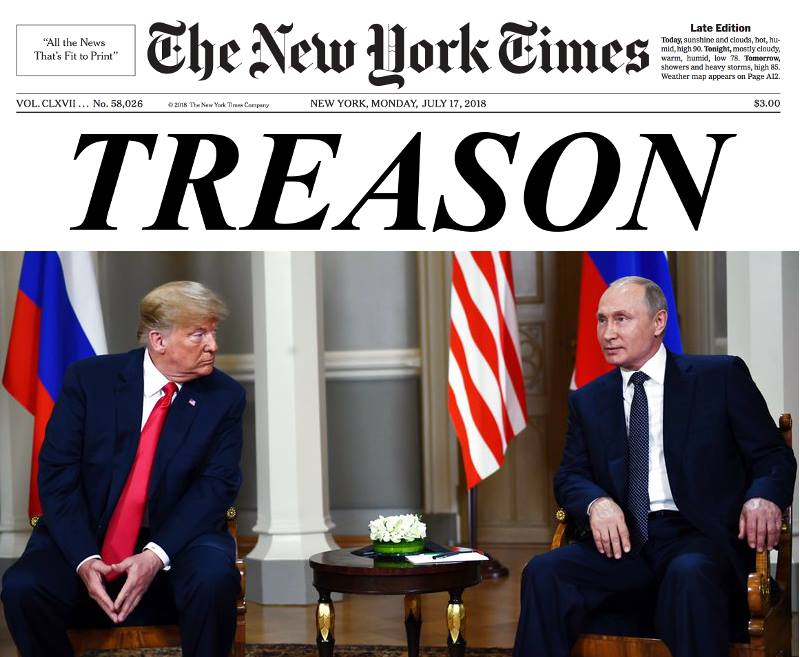 Tomorrow’s front page. Find your courage and make it happen, Nytimes.com. You know it’s the right thing. #TreasonSummit
-
[Dan Rather tweets, “The President… trusts the word of a former KGB agent over the consensus of the American intelligence community backed by a ton of facts… Everyone who excuses Trump’s behavior must answer that now.” Right-wing acquaintance calls it “fake news.”]
Please suppose for a moment that what the left says about Trump is true: his many bankruptcies left his finances in a shambles that he could repair only by becoming an important cog in an international money-laundering scheme dominated by Russian oligarchs and therefore by Putin, and that Trump is therefore dependent on Putin for his very sense of self, since Trump defines himself by his wealth. Putin exploits this dependence to dismantle the institutions (the WTO, NATO, the U.S. State Department) that oppose his ambitions.
The left sees evidence of this hypothesis in everything Trump does, and also in the things he fails to do (like cancel the summit meeting, or at least have others in attendance, or confront Putin, or expel diplomats, or make a speech defending the integrity of our elections, or release his tax returns, or, hell, devise a disparaging nickname for Putin like he’s done for seemingly everyone else). Clearly you do not.
So, question: supposing these things are true, what would it take to convince you?
[Normally prolific acquaintance never replied.]
-
[On the giant Jeff Goldblum statue that appeared in London.]
“What is he, making fun of me?”
-
[Friend says the proposed new slogan for the Democratic party is weak and suggests and alternative.]
I agree “for the people” could be strengthened (is it supposed to imply, “…and not the corporations”?), but I disagree “truth not treason” is a good slogan. It’s unnecessarily inflammatory and confrontational to too many fellow Americans, and focuses too narrowly on one current crisis facing the country.
-
To my supporters: NEVER EVER PAY ATTENTION TO NEWS MEDIA OTHER THAN FOX OR I WILL SUFFER CONSEQUENCES THE LIKES OF WHICH FEW THROUGHOUT HISTORY HAVE SUFFERED BEFORE. WE ARE NO LONGER AN ADMINISTRATION THAT CAN DEFLECT EVERY ACCUSATION. BE CREDULOUS!
-
Aw man, they’re taking away most of the rest of the YouTube video-editing tools. YouTube Enhancements (other than Blur and Trim) are going away August 22
Previously: Requiem for Warhol
-
Welcome to 2018, where our best chance to save America from the corrupting influence of Russia is to embrace socialism.
-
When the breeze is out a-wooing
Who can woo so well?
-
 [In a thread about vanished childhood restaurants.]
For a few years in elementary school, approximately everyone, including me, had their birthday parties in the party room at Jahn’s. It looked like this.
The only thing I really remember from Jahn’s was cheating at a game of Pin the Tail on the Donkey. My victory was tinged with a shame I’ve never forgotten.
-
Wondrous is our great blue ship
That sails around the mighty sun
And joy to everyone that rides along!
-
[Friend posted “CHOOSE THE FORM OF THE DESTRUCTOR”]
Media consolidation.
-
[Right-wing friend posts in favor of Trump withdrawing from the Obama-era Iran nuclear deal.]
Can you explain why you think this is the right policy? I haven’t heard a coherent argument in favor. Maybe if you can articulate yours, I would agree too.
[No answer, but someone else, Allan, writes we’re the greatest country in the world, then asks me why I think Trump’s move is wrong.]
Here’s some of the argument I’ve heard against this policy:
– We abandoned an earlier agreement. This harms our ability to negotiate other agreements in the future.
– We betrayed the allies with whom we negotiated the agreement. This harms our alliances.
– If we’re all stick and no carrot, we back Iran into a corner and compel it to get its own stick.
Here’s where your points don’t ring true with me:
– “We need to let these countries know that we won’t be intimidated by them” In fact everyone can see that nuclear states like Pakistan and North Korea are able to punch far above their weight. With the U.S. behaving in a hostile and unpredictable manner, racing towards acquiring nuclear weapons is Iran’s rational best move. The idea behind the agreement was to give them a better move.
– “They can’t build a nuclear arsenal if we choke off their money supply” That didn’t stop North Korea. Sanctions fall most heavily on ordinary citizens; governments always have ways to fund their most essential projects, and under these sanctions very little will have higher priority than this.
[Allan responds “I don’t believe in giving our country away like most liberals” and “What we really should do is level the entire place and see what grows next.”]
“clearly nothing I say would ring true to you”
That’s not at all clear to me. I just responded to a couple of specific points you made. I hope you won’t generalize from that to conclude we can’t have a discussion. I would genuinely like to understand your point of view better.
I am particularly interested to know what you think “leveling the entire place” means, and what that would achieve.
[No response.]
-
In my dream last night, I was a test pilot flying fighter jets.
Thank you, brain.
-
If you tell a salmon that its fate is to be eaten, I doubt it would be surprised. But I’m curious to know what its reaction would be after you explain that it will be smoked, sliced, and placed atop a bagel with cream cheese and capers and red onion.
-
[Outrage over reports that Google knows your location even if you disable “Location History.”]
That Google has a record of your location even if you turn off Location History in the Maps app is not a surprise, and wouldn’t be news if people were more technologically literate.
Apps that use location data all depend on your device reporting it to them. Restricting one app’s use of that data doesn’t stop your device reporting it to other apps, nor should it.
[Friend objects that people mistakenly expected Google engineers to act with greater integrity.]
The Location History team created a feature that records your location history, and a way to disable that feature. When disabled, that feature stores no data. They didn’t lack integrity: they said what they did and they did what they said. Instead, they were naive: they believed that “disable location history” would mean to users the same thing it means to them.
 The situation is similar to the way people misunderstood Chrome’s “incognito mode,” which resulted in this warning screen. Something similar is needed for “disable location history.”
[Much discussion ensues. Friend comments, “I’ve long been impressed at the mindfulness our pedagogue elders who dominated the academic environment there tried to care about the threat of mass surveillance… The state of Teh Valley is a real shock relative to my expectations of social norms formed back then.”]
I strongly agree with this sentiment. Some of that old guard was among the leadership at Google when I started there, and during my time there a lot of them left, taking a certain antiestablishment ethos with them that was absent in their replacements. I hope that current events are helping to mold a new generation of technohippies.
[Another friend observes, “This puts way too much of a burden on the individual, presumably non-tech savvy, user.”]
The trajectory of my career, and of the industry at large, has been approximately: “Let’s share our love of computers with everyone oh shit everyone has computers now.”
-
Trump is the Icarus of organized crime.
-
[Friend asks, “Is anyone keeping a list of all the stuff we’re going to need to put back eventually?” Another suggests, “System restore to November 7, 2016.”]
You mean, when half the electorate was ready to overlook “grab them by the pussy”? Nooo thank you.
If we put things back just the way they were, we shouldn’t be surprised to find ourselves getting the same result again. How about if we imagine some new better ways we’d like things to be?
-
Lived here looong ago. Weirdly chose today to google “grover cleveland mural” and found this article, which didn’t exist a week ago. @MichaelHPerlman’s tweet
-
[Friend posts, “DO NOT impeach Trump. It will embolden his base.”]
I don’t disagree. But, counterpoint: The Constitution, use it or lose it. If we play politics with enforcing the law, we’re no better than the other side.
Of course the framers recognized that impeachment is in the intertidal zone between politics and law, which is what makes the situation so tricky.
[Discussion ensues.]
“they’ll claim he would have delivered everything he promised if the Democrats hadn’t nitpicked him out of office”
That’s going to happen no matter what, with some Trump supporters. I sense that very many of his supporters are more like this though: @geebobg’s tweet. For those supporters, the important thing isn’t so much letting Trump self-destruct; it’s making the depth of his cravenness and criminality clear and undeniable. (And I agree the way to proceed there is to let this nightmare unspool a while longer.)
-
Escrow fund for orphaned works. Gets $ from the sale of every movie/song/etc. with a copyright whose owner can’t be determined. If you can prove ownership in some copyright, you can draw from the fund. Solves the missing-movies problem?
-
I’m not sure about the premise of this article. I mean, how many diehard Trump voters even know about everything that’s going on? Fox News sure isn’t telling them.
Americans love a strong leader, sure. But they hate being conned. Just wait until the truth of everything starts seeping through to those voters. Nothing Donald Trump can do will drive his voters away: If last week didn’t do it, what will?
[Discussion ensues. Friends doubt Trump supporters will ever realize they’ve been conned.]
I don’t think I made my point clearly. It’s this: Fox News and other similar outlets have done a very effective job of cocooning much of the nation in pro-Trump propaganda on the one hand, and on the other hand training viewers to reject information from unaligned sources when it leaks into the cocoon. Under that premise, there is no mystery to Trump’s rock-steady base: they simply haven’t gotten the memo. Inevitably, they will, and they will hate, hate, hate how they’ve been manipulated.
[“I think you’re overly optimistic here, Bob.”]
Well, if I’m overly optimistic it wouldn’t be the first time. But note, I’m not claiming that some diehard Trump supporters won’t remain – clearly some will, no matter what. I’m claiming that very many supporters aren’t the diehard-no-matter-what types, and we haven’t heard from them only because they’re shielded from reality. When that shield fails, the situation won’t be exactly analogous to Nixon, who, for all the wrong he did, never seriously betrayed conservative principles, and even did some good while in office. Trump has neither of those advantages.
This is, after all, the country that elected Barack Obama and popular-vote-elected Hillary Clinton.
[A friend writes, “I’ll be wearing my YGG cap – You Got Got!!”]
A sure way to inhibit those who might otherwise be ready to admit they were wrong.
-
An update on TxVM, Chain’s blockchain transaction format and contract language. With examples! Feature development with TxVM
-
[Left-wing friend posts chart showing soaring corporate profits and stagnant wage growth. Right-wing friend responds with CNBC article, “Pay gains during Trump’s first year in office are the best since the Great Recession. I read and fact-check the article.]
The headline, and much of the text in the article, is misleading. It cherrypicks a statistic called the Employment Cost Index, which is the cost to employers of the wages they pay and the benefits they provide. This number is indeed higher than at any time during the Obama administration. But it’s also not a “headline” statistic (i.e., one you hear about routinely in the news) because it does not convey the experience of ordinary Americans.
I won’t include a link here because you’ll accuse me of cherrypicking in return, but I encourage you to Google the phrase “u.s. wage trend” and click through to multiple sources. What you’ll see is that wages are doing OK, but not superlatively so.
[Right-winger writes, “Are you saying that the media from mainstream nbc news is misleading the people by fake news or filtered news or biased facts and misleading headlines? I need only subscribe to the articles you trust? Is that what you are saying?]
Nope. I’m saying that article is misleading. I am not generalizing to NBC as a whole, the mainstream media, or anything else. I am recommending that you synthesize your information from a cross-section of different sources (for all things, always, not just politics), because you can’t tell in isolation when a particular source is biased. Even if that source is me 😉
-
Something fun!
I’d like to try out some quiz questions about technological literacy. Care to be a guinea pig? Answer any of these questions in the comments below. Please, no cheating by looking things up or asking around: just state your own understanding.
Please don’t be shy: my expectation is that everyone outside the computer industry has wrong or incomplete ideas about these questions. I’m interested in what those wrong or incomplete ideas are. COMMENTS THAT SHAME OR RIDICULE OTHERS’ ANSWERS WILL BE DELETED.
SORRY, COMPUTER-INDUSTRY FRIENDS, YOU’RE EXCLUDED. But feel free to suggest your own questions in comments below.
1. What is the difference between the Internet and the World Wide Web?
2. What is the difference between Google Chrome and Google Search?
3. What is the difference between HTTP and HTML?
4. What is the difference between HTTP and HTTPS?
5. What are cookies?
6. What is an operating system?
[After a while, and some interesting responses…]
Thanks to everyone who participated. Most of your answers were better than I expected! Here’s my attempt at answering each question briefly.
1. What is the difference between the Internet and the World Wide Web?
The Internet is a global collection of computers and the electronic connections between them. The resulting network supports a variety of data-transfer applications: file transfer, using the file transfer protocol (FTP); e-mail, using the simple mail-transfer protocol (SMTP); and hypertext, using the hypertext transfer protocol (HTTP).
(The word “hypertext” denotes linking a collection of text documents to one another.)
The World Wide Web is a subset of the Internet. It consists of those computers that know how to respond to HTTP requests, a.k.a. “web servers.” Depending on your definition it also includes those computers that know how to issue HTTP requests (a.k.a. all the rest of us, surfing the web).
2. What is the difference between Google Chrome and Google Search?
Google Chrome is a web browser: an application that knows how to issue requests to web servers, and display the results. Other web browsers include Firefox, Safari, and Internet Explorer. They all do more or less the same thing.
Google Search is a (super duper) web server with access to an index of all the world’s websites, more or less.
3. What is the difference between HTTP and HTML?
HTTP is the hypertext transfer protocol. It describes the format of the messages used behind the scenes in requesting and supplying web pages and related content. When you click on a link, your computer “speaks” HTTP to the relevant web server, saying “give me document so-and-so.”
HTML is the hypertext markup language, the format of web pages. An HTML document contains text and special notations that tell your web browser how to display it: “start a new paragraph here,” “embed an image here,” and so on.
HTTP and HTML are related. Many HTTP requests result in the delivery of HTML-formatted documents. But HTTP delivers many types of data, not only HTML documents. For instance, if an HTML document contains an embedded image (which is not, itself, HTML), a separate HTTP request is used to retrieve it.
4. What is the difference between HTTP and HTTPS?
HTTP is the hypertext transfer protocol. The requests and responses made using HTTP are in “clear text,” meaning anyone eavesdropping on the connection can read everything going by.
HTTPS is a version of HTTP in which requests and responses are encrypted. They are intelligible only to the intended parties. Eavesdroppers see only indecipherable gibberish. (The S stands for “secure.”)
(This might not be so important except for the design of the Internet: it’s essentially made of eavesdroppers. Every message passed between two computers may end up routed through a dozen others en route, behind the scenes. Each computer along the route inspects the message to learn its ultimate destination – and may do more intrusive inspection too.)
5. What are cookies?
When you go to a club or a theme park, you get a handstamp. If you leave, the handstamp lets you get back in without having to buy a new ticket or pay a new cover charge.
A cookie is similar: after you sign in to a website, the web server may ask your browser to store a cookie – typically a short alphanumeric code – and present it for inspection the next time you return. This happens behind the scenes, as a built-in part of HTTP.
Unlike a handstamp, each visitor to a website gets a distinct cookie. Your alphanumeric code is unique. It’s how websites know it’s you the next time you show up, without requiring you to log in every time.
6. What is an operating system?
An operating system is a gatekeeper restricting access to a computer’s resources: its memory, its disk drives, its network interface, its screen, its keyboard and mouse, and more. Any software that wants to run on a computer needs to know the proper way to ask the operating system for the resources it needs.
Each operating system has its own way of requesting access, which is why software written for Windows is incompatible with software written for Android which is incompatible with software written for iOS (all examples of operating systems).
[An alternative set of answers in a separate, individual reply.]
For all the ridicule it got, I have long thought the “information superhighway” was a decent analogy for introducing the masses to the Internet in the 1990’s.
If the Internet’s a series of roads and the computers are houses and other buildings connected to those roads, then:
1. The World Wide Web is warehouses full of books.
2a. Google Chrome is the errand runner you employ to bring you books from those warehouses – and read them to you.
2b. Google Search is the expert who knows which warehouses contain which books, and which books contain which words and phrases.
3a. HTTP is the collection of order forms and receipts needed to request and receive books from the warehouses.
3b. HTML is the layout and typography of the books.
4. HTTPS is a lockbox in which your errand runner carries your order form to the warehouse, and the book they bring back. Only you and the warehouse owner have the key.
5. Cookies are handstamps given to your errand runner by warehouses they frequent.
6. An operating system is a set of keys to the rooms of a house. All the rooms are locked and there’s only one set of keys, so everyone has to take turns using them.
These analogies aren’t perfect of course, but they’re not too bad.
-
 Cloud eggs!
Cloud eggs
-
[Right-winger asks in a comment thread about voter suppression how we think Republicans are suppressing votes.]
In the past: literacy tests, poll taxes. Today: voter ID laws, targeted poll closures.
[Right-winger responds Voter ID laws are not suppression, they ensure the integrity of the vote.]
That’s the rationalization. But when there’s no demonstrated need for preventing widespread voter fraud, and when the demonstrated effect of voter ID laws is to discourage turnout by traditionally Democratic voters, it’s easy to see why Republicans would enact it under the guise of ensuring electoral integrity.
I’m not saying Democrats are above using a similar trick if one existed. It’s what political parties have always done. It’d almost be malpractice for them not to try. But we must all resist such things in the name of fairness and democracy.
“the polls in my county are controlled by the county registrar of voters, not republicans”
Can you explain why there were 868 fewer places to vote in 2016 than in 2012, and why the closures overwhelmingly affected Democratic voters more than Republicans, without invoking partisan shenanigans?
To doubt that political parties have influence over elections, or that they will use that influence to their benefit within the bounds of the law and sometimes beyond, is to be willfully naive.
-
[Friend posts that there are more than 500 children in detention still separated from their families. Right-wing person writes a “so-what” response.]
“I guess their parents should have thought about the consequences to their actions”
They did. They thought (for example) “Stay in Sinaloa and have my son murdered if he doesn’t join a drug gang? Or go to the land of opportunity?” What choice would you make?
“This has been going on for years. Why is it such an issue now?”
Are you suggesting that crimes against humanity get less bad the longer they go on, not worse? Should we not have emancipated the slaves?
-
This feels like one of those captures-the-whole-zeitgeist historic photos. @andyharnik’s tweet
-
[Right-wing friend posts message agreeing with comments made by Senator Sasse (R-NE) at the Kavanaugh confirmation hearing.]
This is a terrific speech, and I strongly agree with most of it.
It falls apart near the end, though. After eloquently laying out the ways in which we’ve drifted away from the Founders’ design, Sasse rightly says we need to restore the Constitutional balance of responsibilities between the three branches. But he doesn’t say how to do that – yet he urges the Senate to proceed with Kavanaugh’s confirmation as if that restoration of balance is a done deal.
It would be nice if it were a done deal, or if there was even a plan for getting that done. But it’s not, and there isn’t, so ultimately Sasse is asking everyone to evaluate Kavanaugh for a job that doesn’t exist: non-super-legislating Supreme Court Justice.
I have some thoughts on how the legislative branch grew less responsive. It is due, at least in part, to the shrinking size of Congress in proportion to the growth of the country. Homeopathic democracy
By the way, was anyone else amused when Sasse used the occasion of a Supreme Court confirmation hearing to make a grandstanding speech that included criticism of senators who make grandstanding speeches during Supreme Court confirmation hearings?
-
Now it can be told! This is a very exciting time. Apologies to those of you who’ve gotten only the blandest answers from me these past few months about how work is going. Blockchain company Chain acquired by Stellar
-
[Trump disputes the death toll from Hurricane Maria, saying 3,000 people did not die in Puerto Rico.]
Perhaps he means that there are 3,000 people in Puerto Rico who did not die.
-
[During the Kavanaugh confirmation hearing.]
“There are many accomplished men and women in the judiciary, champions of conservatism, whom we can be proud to elevate to our nation’s highest court. Until we find one who cannot be credibly accused of perjury and rape I will withhold my vote.” – Any Republican senator, please.
-
I’ve seen Gary-Kurtz-produced Star Wars, and I’ve seen non-Gary-Kurtz-produced Star Wars, and I know which I prefer.
RIP, unsung hero of a galaxy far, far away.
-
[In comment thread, right-wing guy repeats complaints about accusations against Brett Kavanaugh.]
“accusations without proof or any kind of hearing or trial”
How else is it supposed to work? Trial first, then accusations?
-
[Friend seeks suggestions for questions to ask two female Supreme Court Justices whom she was going to see.]
Is there a looming crisis of legitimacy for the Court based on the trend of Justices confirmed with less and less political support (see Seems legit) and, if so, what to do about it?
-
This is who Anthony Kennedy wanted to succeed him.
-
I invite the FBI to reveal to the world anything they can learn about my past, if they choose. And I’m not even trying to get on the Supreme Court.
-
[Friend posts that right-wing complaints about due process (regarding accusations against Brett Kavanaugh) are missing the point that the confirmation hearing is a job interview, not a trial.]
Another view: “due process” in this case means slow the fuck down. The ones screaming due process are conveniently overlooking that.
[Friend objects to using the phrase euphemistically.]
What I mean is, there is a process, and it is due, in the sense that it’s one the Senate has followed for confirming all Supreme Court justices in the modern era. It’s not a euphemism; it’s just not the specific legal doctrine for which “due process” is usually shorthand.
-
It suits the GOP to be alienating women, at least in the short term, because as long as we’re all worked up about sexual assault, it fits into a certain namby-pamby-liberals frame, and distracts from the concealing-evidence story and the Trump-choosing-the-judge-who-will-shield-him story.
-
Reasonable people can disagree about whether Blasey Ford “proved” her allegations against Kavanaugh. But no one can disagree about the behavior we saw on display.
-
[In reply to @OfficialJonZal’s tweet]
Exactly. There’s no shortage of qualified conservative judges. What’s needed is a reliable partisan operative to protect Trump and his enablers, because the threat to them is real and imminent.
-
[Friend posts about patriarchy (not men) being the enemy of feminism. Another calls out women who support the patriarchy.]
Before condemning women who have supported the patriarchy, listen to this episode of the Scriptnotes Podcast, featuring guest Aline Brosh McKenna, successful screenwriter and co-creator of Crazy Ex-Girlfriend. She gets passionate about the boys’-club nature of Hollywood and the lack of good options for women, especially young women, who want to stand up for themselves. She describes instances of going along to get along in her own career, and regrets those, but observes that (though things have gotten incrementally better in the past couple of years) there are still no systematic mechanisms for addressing bad behavior by creepy execs. Of course this generalizes from Hollywood to society at large. One year later
-
OK, “party of law and order,” what do you have to say now? Trump Engaged in Suspect Tax Schemes as He Reaped Riches From His Father
-
[Friend reposts appreciation of Walter Cronkite, misguided because it says Cronkite simply read the news and we all made up our own minds.]
It isn’t so much that we made up our own minds as it is that we trusted him. It was a trust he earned through his gravitas – which is not just seriousness and is definitely not neutrality. Here is an excellent article on this topic: Lessons From Walter Cronkite in the Lost Art of Gravitas
-
Why are they so committed to Kavanaugh?
Because he’s a reliable vote to frustrate investigations into Trump.
Why are they so committed to protecting Trump?
Because they’re culpable too. If he goes down, they go down.
Solution: Amnesty for Trump’s enablers in Congress. They can even keep their dirty money. All they have to do is to come clean about everything.
[Friend: “Sadly, they have no reason to negotiate.”]
Not necessarily true. Right now it’s a race to dismantle the machinery of justice that might eventually be brought to bear on all of them. Surely some of them fear that won’t happen in time, and they’ll end up in prison etc. Safer to take the amnesty deal and rat out the big fish.
-
Increasingly feeling like we’re going to have to relitigate the 20th century. But this time around we start with nuclear weapons, 400 ppm CO2 in the atmosphere, and a decimated press.
-
[Friend mourns the death of American Exceptionalism.]
Same. But to be fair, American Exceptionalism has a serious dark side. I’m hopeful about what the young people will eventually build to replace it, and fearful of what it will take to get from here to there.
-
I started writing a tweet. Then I deleted it. I have a virtuous, cleansing sensation.
-
Cons:
– Perjury
– Credible accusations of assault
– Concealed records
– Inappropriately emotional
– Inappropriately partisan
– Rushed, constrained investigation
– Rushed confirmation
Pros:
– Is a judge
– Likes beer
Seriously: on what principle other than “own the libs” do conservatives support this nomination?
[Much discussion follows.]
I’m not wondering why the politicians support it. That’s pretty clear IMO. (“A properly functioning judicial system is a threat to me.”) I’m wondering why their constituents do.
[A friend explains, “‘Those other guys are shedding decency in favor of partisan politics’ is the story line for both sides.”]
This is where you lose me. The objections against Kavanaugh were based on principles that both sides claim to care about: transparency, due process, honesty, character. The arguments in favor of Kavanaugh were… what, exactly? “Don’t let the libs stop our guy”? Is that really it? What does a Kavanaugh supporter – a thoughtful one – say when confronted with the facts of his demonstrable lies, or the missing documents, or the sham investigation?
[Friend writes, “you’re going to have to engage an actual supporter”]
I do try from time to time, though I knew few such people. Though I am sincerely respectful in asking for their views, I never get a thorough, coherent answer. Even when it starts well, it only takes my asking a couple of clarifying questions for things to devolve to defensiveness and paranoia or, more often, just disengagement when we get to stuff the talking points don’t cover.
[Friend writes, “They can’t all be immoral idiots, his supporters.”]
I am willing to believe that virtually all of those people can be explained by the filter bubble they live in. They are behaving perfectly rationally, even decently, given the information they have.
[Friend asks, “So how’s our information superior?”]
Asked like a true scientist. Which is also the answer to your question. It is my strong impression that only (what I will advisedly refer to as) our side seeks to understand other points of view, questions our own beliefs, and grounds arguments on data and principle – i.e., is rational in the Enlightenment sense.
It may be that some of that impression is due to my own filter bubble, but as I said earlier, some of it is from direct experience.
Clearly few or none of us are perfect at it: clinging to unquestioned opinions, failing to consider alien ideas, etc. But our side at least strives for the ideal. I see no such thing happening or even possible on the other side. I would love to be wrong about that but I don’t see how I can be; hence this thread. (In which, by the way, thanks, everyone, for engaging.)
-
[Comment thread after Kavanaugh was confirmed. Someone wrote, “Justice Kavanaugh is superbly qualified to sit on the Supreme Court bench.”]
How do you know? The majority of relevant documentation was kept concealed. The FBI investigation, if you can call it that, was constrained and its report secret. The confirmation process itself was rushed beyond reason, to frustrate proper vetting.
Almost the only thing we do know for sure is that, under pressure, Kavanaugh is inappropriately emotional and incoherent.
So, again, what makes you say that Kavanaugh was the best choice?
-
 This sign EVERYWHERE Police Removed A Texas Yard Sign Showing A GOP Elephant With Its Trunk Up A Woman’ss Skirt
-
This story reminded me of a conversation I had many years ago with Julie Epelboim. We had just seen Star Trek IV: The Voyage Home together. Kirk and his officers are in hiding from Starfleet, fugitives for stealing the Enterprise in Star Trek III. When Earth comes under global threat, however, they leap into action to save the day, even though they know that if they succeed they face immediate court-martial.
Julie and I discussed whether we would make that same choice. “Of course!” I insisted at once. “Not me,” said Julie. I couldn’t understand her perspective. Earth! Under threat! A call to heroism! How could you not rush to the planet’s defense even at the expense of your own freedom?
It occurs to me that we all now have exactly that choice to make.
We need massive change to avoid climate hell
-
[Friend reported running into Lynda Carter, “the original Wonder Woman.”]
Lynda Carter as Wonder Woman was 💯, but the first Wonder Woman she was not. She wasn’t even the second!
Wonder Woman 1967 Screen Test
Cathy Lee Crosby, the original Wonder Woman
-
[Comment thread: local high schoolers walked out of school to protest Kavanaugh. Right-winger Chris condemns them and says public education is a joke. It should teach them “innocent until proven guilty.”]
Why do you think “innocent until proven guilty” is applicable in this case? The Kavanaugh hearings were meant to determine his fitness for an important job. They were not a trial or any other process that might have ended in depriving Kavanaugh of basic rights.
In fact, when evaluating a job candidate, the opposite of “innocent until proven guilty” is true, and rightly so. Do you think an employer should be required to hire the first person they cannot show is a criminal?
[Chris points out Kavanaugh underwent numerous background checks and it’s unfair for someone to show up at the last minute to torpedo his nomination.]
During part of my time at Google I served on a hiring committee there, and a situation very like this actually came up. A candidate who’d been through three rounds of interviews, each involving multiple interviewers, made it to the final step of hiring, when following up on a reference revealed some pretty bad blood he’d left behind at one job. Whether or how much that account was true didn’t matter: we were under no obligation to hire him, and the risk of bringing on someone who might behave unprofessionally was enough for us to reject him. There were plenty of other qualified candidates.
I’m sure this sort of thing happens all the time, everywhere.
Now, three rounds of interviews, each involving multiple interviewers, are not FBI background checks. But this was for a software engineering job, not a seat on the Supreme Court, so proportionally I’d say it’s comparable.
[Chris asks what that candidate said when we asked about the rape allegation from 36 years ago.]
I appreciate your continuing to engage on this topic. I would like to find common ground if possible, and if not possible, I’d like to understand why.
Your point, though crudely put, is well-taken: we did not confront the job candidate with the accusations against him. We had no reason to, because there were plenty of other good candidates with no alleged skeletons in their closet, so why expose ourselves to the risk?
The analogy with Kavanaugh breaks down (as I believe you are trying to point out) because we never considered the possibility that someone was deliberately trying to sabotage an otherwise qualified person. Nor did we have reason to suspect that future candidates would be similarly sandbagged. This is the mindset that I presume Kavanaugh partisans had.
If we did have that suspicion, or if we were short on qualified candidates, we obviously would have tried to get to the bottom of it. We would have started by confronting the candidate with the allegation and noting his response. Belligerence and deflection would have been an immediate red-buzzer moment. Next we would have tried to investigate the complaints against him in greater detail. To do that we would have identified anyone claiming to have information on the subject, interviewed them, and asked to see supporting documentation. We would not have imposed constraints on the investigation’s ability to learn the truth of the matter, and we would have regarded as highly suspicious any attempt by the candidate to do so.
In short, even with the flaws in my analogy, your point fails to support the historically hasty and suspiciously secretive nomination of Kavanaugh. The alternative explanation – that it was a naked abuse of power, only the latest in a long and increasingly brazen string of them – more than justifies the Terra Linda kids skipping school to protest. They will have to live under a weakened democracy longer than any of the rest of us. Honestly it’s a wonder any of us can go about our normal business at a time like this.
-
[Friend posts, “Hey, if you’re a rich white guy, I get your voting republican. But if you’re not part of the 1%, you’re voting against your own interests.”]
Even the rich white guys voting Republican are voting against their own interests. History is very clear about what happens to societies with overwhelmingly lopsided and unjust concentration of wealth.
-
It’s now or never. If we fail to make a good showing in this election, we’ve endorsed the naked exercise of unchecked power, and we know how things go from there.
The Senate is key, and though the odds are long, they’re no longer than Trump’s were at this time two years ago. WE CAN DO IT.
How? By GIVING UNTIL IT HURTS. (If we fail, it’ll hurt ever so much worse.)
Where? Glad you asked. I’ve devised an “urgency index” for the seven most important Senate races, based on data from fivethirtyeight.com. It suggests how to allocate your donations depending on whether you want to support 1, 2, 3, 4, 5, 6, or all 7 of those races. See the table at the link below, which also includes handy donation links for each campaign. I will periodically update the table as fivethirtyeight.com publishes new data.
Urgency index
-
 Birthday gift from my family: hiking into the rainforest, making a pilgrimage to the One Square Inch of Silence. It was amazing.
The spot is marked with a red stone, which you swap out for one that you bring. As I was about to do that, Jonah reminded me to make like Indiana Jones swapping the idol for the bag of sand.
[Sister wrote, “Jonah had to remind you to do that? You’ve changed, old man.”]
It’s not the years, honey, it’s the mileage.
-
It’s launch day on my latest work project! Starlight: Payment channels on Stellar
-
Not voting is voting, but for the other side.
-
Every now and then I rev up my imagination and my generosity to max, and I try to imagine Donald Trump experiencing a single genuine moment of tenderness, grace, or humility. I have not yet succeeded.
[Discussion about what a tragic character Trump would be in literature; also about his supporters.]
“Can you have a free society with 1/3 ignorant racists?”
Taking America as an example, I think the answer is “yes, somewhat,” depending on how much you consider America to have been a free society. Obviously it has been more free for some than for others at different times.
I think the lesson of the past few years (and of much other recent history) is that the ignorant racists and other antidemocratic elements have always been there and always will, and it’s up to society to keep their power from coalescing. When the rest of us become complacent (we elected a black president, yay!) they become ascendant.
How does one keep the power of ignorant racists in check? Possibly by the simple expedient of convincing them that their beliefs are out of the mainstream. For a fascinating discussion of this topic, check out this episode of the Hidden Brain podcast, about an effort to heal Rwanda after the racist genocide there: Romeo & Juliet In Kigali: How A Soap Opera Sought To Change Behavior In Rwanda. (Spoiler alert: it worked not because it changed people’s deepest beliefs, but because it changed people’s minds about what other people believed.)
-
[Comment thread about reports that voting machines in some places were misreporting votes. One commenter said they’d like a printout of their vote but even that’s not foolproof.]
The problem with a printout is, now you can prove to someone else how you voted, which means they can offer to pay you to vote a specific way. That is not a world we want.
Designing verifiable balloting systems is seriously non-trivial and the focus of much research. The requirement I mentioned is sometimes referred to as “receipt-freeness,” which obviously is in tension with some other requirements. See End-to-end auditable voting systems.
-
[Friend Greg’s birthday.]
“Why is it that we rejoice at a birth and grieve at a funeral? It is because we are not the person involved.” – Mark Twain
Happy birthday (I guess)!
-
[On an unrelated post, friend-of-friend goes on an unhinged rant against girls “claiming themselves as boys” and vice versa and wanting to use the other bathroom.]
I am tall, trim, and muscular. I’m thirty-five years old and I have 20/20 vision and a full head of hair.
You wouldn’t know this to look at me, though. Outwardly I’m short, balding, and fifty-two, and I wear a pair of reading glasses on a cord around my neck. On a good day I can do one complete chin-up.
Little of that affects how I feel about myself inwardly though.
I imagine this is what it’s like when someone feels like a man or feels like a woman but outwardly isn’t. Is your back just the way it “should” be? Are your knees? Your teeth? Nature makes mistakes. Nature creates variations.
Honestly it would be more surprising if gender wasn’t sometimes fluid. There’s more to maleness and femaleness, after all, than just what’s between your legs. There are differences in hormonal balance and brain structure, for example. These things are determined by a cascade of complex processes that begin with just a few individual molecules in the womb. How naive to think that the outcome of those processes would be the same every time.
So how should we feel about trans people? Some of the ones I know are terrific. Some are assholes. Just like everyone. We can judge them, but let’s do it apart from their gender identity, OK?
-
[Sister’s birthday.]
Twenty-nine years ago* yesterday I got the best present I’ve ever received. I haven’t stopped loving it since. Happy birthday, Suze!
* – or more
-
[One week to Election Day.]
Bad news: If we win next week, the fight is still only beginning.
Good news: If we lose next week, the fight is still only beginning.
Stay strong.
-
Something symbolic happened to me this morning.
I sat down in a Muni train on the way to work, facing forward, earbuds in as usual, listening to podcasts. A black man in a Muni security uniform sat down in front of me on a seat facing the aisle, at a right angle to me.
At one point while we were en route he gave me a look, then looked past my shoulder.
Only then did I become aware that a scary disheveled man sitting a couple of rows behind me was ranting loudly to another man standing in the aisle, and had been for a while. A young woman trapped in the window seat next to him looked very ill-at-ease.
A moment later, while I was still taking in the scene, the security guard got out of his seat, stepped over to where the disturbance was happening, and offered his hand to the young woman.
She gratefully accepted his help, squeezing past the ranting man (who paid no notice) and taking a new seat near us, visibly relieved.
Here’s what was symbolic about that:
I, a white man, was oblivious to the bad shit happening around me, wrapped in my bubble of privilege that allows me to assume everything will be fine. But really, things are often not fine. It took a black man, who knows better, to see the bad shit and do something about it.
I do wish to become more a part of the solution and less a part of the problem, but clearly I still have some way to go.
[Later…]
PS: I do belatedly realize the chauvinism of saying this is something that happened “to me.” Baby steps…
-
[Pun-loving cousin’s birthday.]
Tried to come up with a pun for your birthday. Asked my friend Ted for help. We couldn’t think of one, so I punted.
-
“Make America Great Again”
If you’re white and not poor, America has been pretty consistently great for a long time. But there are plenty of others for whom it hasn’t always been great, and some for whom it never has.
Lately, the veil that protected us middle-class white folks from knowing about the ungreat America has started to wear thin in spots, and at long last we’re getting a good look at the America others have known. Of course we don’t like it.
We can’t make America great “again” if it wasn’t great to begin with, for some people. The only thing we can do “again” is pretend we didn’t see what we saw and try to get back to it being great for just us, somehow.
I wouldn’t bet the farm on that being possible. And I wouldn’t do that to my conscience even if it were.
America won’t truly be great until it’s great for everyone, so let’s Make America Actually Great Once And For All.
-
[On whether to re-elect local school board member Natu Tuatagaloa.]
To Natu or not to Natu?
-
[In a comment thread about debating abortion.]
I haven’t ever gotten an actual anti-abortionist’s response to this, but here’s how I prefer to argue the topic: Do the abortion math
[“have you ever heard even anecdotal evidence of anybody ever changing their mind”]
Sort of. I’ve heard of pro-choice women wanting abortions and finding themselves unable to go through with it; and I often hear about self-righteous anti-abortion male politicians and religious leaders revealed to have hypocritically gotten an abortion for some mistress.
[“this argument is terrible!”]
I sort of intended it to be terrible in the same way that “democracy is the worst form of government except for all those other forms that have been tried.”
-
[Friend reposts what appears to be a Russian-bot tweet, unfavorably comparing the chaotic election with the efficient lottery-ticket system, claiming the chaos is on purpose.]
Designing elections is much harder than designing lotteries. Elections need “enforced secrecy,” lotteries do not. Elections need to enforce one ballot per registered voter, lotteries do not.
-
[Comment thread about Roald Dahl writing the screenplays for both Chitty Chitty Bang Bang and You Only Live Twice.]
Also, Ian Fleming wrote both novels.
[Friend-of-friend comments, “And I believe that Dahl and Fleming had a relationship from the secret service, where Dahl was a Mata Hari for British Intelligence, sleeping with diplomats’ wives to gather pillow talk.]
I am so happy to know that fact.
-
[Friend posts photos from Bend, Oregon.]
I’ve taken my family on many roadtrips and we’ve been through many towns on the way to our various destinations. None of them had the instant magnetic pull of the half hour we spent in Bend (on our way to last year’s eclipse) and we’re determined to return for real ASAP.
-
 I have a feeling my mom would not have liked the age she would have been today. But we sure would have loved her sticking around a little longer. Happy birthday, mom!
-
[Posting in the “Omnibus Futurelings” Facebook group about an episode of the Omnibus podcast.]
Belatedly listened to “The Letter J” and learned about John’s desire to be called Peter.
That made me remember Short Time, a Dabney Coleman comedy from 1990. (It had the bad timing to name its main character Burt Simpson just as The Simpsons was becoming big.) He’s a mediocre cop who’s mistakenly told he has a terminal illness. Hoping to be killed in the line of duty for the death benefit his family will receive, he becomes a heroic supercop! (And, spoiler alert: repeatedly fails to be killed, and learns a new appreciation for his life and family along the way.)
In one scene he bravely walks into a hostage situation in a convenience store to talk down a bomber who wants to blow himself up and his hostages with him.
Simpson: Go ahead and blow yourself up if you want. Sure gonna be missing a lot. Do you have any kids?
Bomber: Nicky and Mikey.
Simpson: Nicky and – how old are they?
Bomber: Three and a half and five.
Simpson: Well if you’re gone, who’s gonna see they graduate high school? How are you gonna find out whether they found a nice girl? Whether Mikey’s stutter ever cleared up?
Bomber: Mikey doesn’t stutter!
Simpson: I understand. But just saying he did. There’s so much… there’s so many things you wouldn’t even notice until they’re gone. Like, Nicky – can Nicky ride a bike?
[Bomber shakes head “no.”]
Simpson: Don’t you wanna teach him to ride a bike? Or see him get his braces? Finally touch the top of that door jamb?
Bomber: How do you know about the door jamb!
Simpson: Pal, come on. You may think you know him but I bet you don’t even know who his teacher is. Or the names of the monsters in his room. [becoming reflective] Or why he buried his shoes that time. Or why he made you call him “Peter” for a whole month.
-
Headline on the MSNBC website right now: “Clintons back in spotlight as they kick off paid speaking tour.”
A more accurate headline would be, “Clintons back in spotlight as MSNBC reports on Clintons.”
-
As we all know, cool guys don’t look at explosions.
Question: what was the original explosion a cool guy didn’t look at?
I don’t know the answer. I have a guess, but I’ll keep it to myself for now. Cool Guys Don’t Look At Explosions
[Later…]
Here’s what I was thinking of: Goldfinger clip
It’s only a proto-cool-guy-not-looking-at-an-explosion, though. He’s not walking away from it while it happens in the background, and his not-looking-at-it doesn’t convey he has zero fucks left to give (which is the storytelling point of cool-guy-not-looking-at-explosions scenes). For that I submit James Caan blowing up his house and businesses near the end of Thief (1981).
-
Trying to lose a little weight again. Finding that intrusive thoughts about food are coming up about as often as intrusive thoughts about sex did during puberty.
-
[Comment thread about favorite Christmas movies, starting with It’s A Wonderful Life.]
Pocketful of Miracles. Also by Frank Capra (his final film), also a terrible title.
-
[In a thread converting quotes from Die Hard into fake Medieval English.]
Come thee to the seashore, well-met wilt thou be, merry shall we make.