2013: Cleverness in review

If you don’t slavishly follow my every utterance on social media you might have missed some of these during the past year. (Now you’ll know what you need to do in the year to come.)

(Previously: 1, 2, 3.)

  • The power of Downton Abbey: five minutes into the first episode of the first season, I, an avowed coffee drinker, hit pause and went to brew myself a cup of tea.
  • George W. Bush
    Nude self-portrait in shower
    Please, not Cheney next
    #newshaiku
  • [On the resignation of Pope Benedict XVI] Too pooped to Pope.
  • My Uncle Al died today. I and many others will miss him. As sad as that is, it’s not nearly as sad as it is awesome that he lived. Funny, friendly, a mensch. He knew that the best kind of success is a large and loving family. If I have half the success he had in that department I’ll count myself lucky. If only all that love didn’t have to turn to sorrow now.
  • Do you think that, when a dog sees someone they love coming closer, they’re all like, “OK, be cool,” but always forget about their tail totally giving them away?
  • All this speculation in the trade press about the iWatch and similar devices, and not one mention of Dick Tracy. Am I too old, or are the reporters too young?
  • Three words that I wish had different meanings so I could use them more: eleemosynary; chupacabra; speculum.
  • Everyone’s giving Obama a hard time for his “Jedi Mind Meld” comment, as if he doesn’t know the difference between Star Trek and Star Wars. In fact he’s one step ahead of everyone else, having heard that Star Trek director JJ Abrams will next be directing Star Wars. They just didn’t get the joke.
  • Four episodes in on Homeland, one of the vaunted “best shows on TV.” Not one thing that has happened has been surprising or interesting. Nothing rings true. There’s a lot of gratuitous fans-expect-it-because-it’s-cable swearing and screwing. And not only do I not care about any of the characters, I think I actively dislike all of them. Maybe that’s the whole point, but I don’t care – I give up.
  • [After “springing forward.”] Attention daylight savings time whiners: you were happy enough getting that extra hour last fall. That doesn’t come for free, you know.
  • Gave Andrea a bouquet of eight roses this morning, and a card with this poem: “Long ago / In ’88 / We went on / A datey-date / Each day since then’s / Been greaty-great / All eight thousand eight hundred / Eighty-eight!”
  • I know this is probably obvious, but it’s still striking: walking around the offices of YouTube, you hear the word “video” an awful lot.
  • [Neither half of this rhyme is actually true, as far as I know, but it popped into my head anyway and I had to share it.]

    Kids in France
    They drink wine
    Moms and dads there
    Think it’s fine

    Give some wine
    To your kid here:
    Consequences
    Are severe

  • Calling him a film critic is selling him short. Goodbye Ebert. “I think I’ll miss you most of all.”

  • I told the kids, “You’re my Project Tomorrow.” Archer said, “I thought we were your Project A Few Years Ago.”
  • I am thrilled by the trend of progressive political victories in such areas as gay rights and easing marijuana prohibition. But, not to detract from those hard-fought battles, I have to say they feel to me like chipping away at the edges. There are big systemic problems in America needing progressive solutions, like the broken system of incentives in Washington, or the power imbalance between citizens and corporations. Next to that the right to smoke a joint is bread and circuses. Can we focus some progressive power on the big problems?
  • This week I got terms-of-service update notices from Netflix and from AT&T, both emphasizing new mandatory-arbitration clauses, forcing me to choose between their services and having access to my country’s legal system. This needs to be made illegal.
  • I think the time is right for a Spider-Man re-reboot.
  • Major TV hosts of the 50’s: Milton Berle; Sid Caesar; George Burns; Groucho Marx. All Jewish. Major TV hosts since then: Steve Allen; Johnny Carson; Merv Griffin; David Letterman. Not Jewish. Discuss.
  • The paradox of politeness: when someone’s assisting you with something, and you tell them “take all the time you need,” they’ll go faster for you.
  • Wore a polo shirt the other day, first time in many years. Jonah said, “Dad, you’re buff!!” In the next instant he lifted up the front of my shirt and took a look. “Oh, never mind.”
  • It bothers me that movie _trailers_ get hyped-up premieres.
  • [Capsule summary of Man of Steel.] It’s a wonder there’s any of Metropolis left after all the kablooey.
  • The first thing I ever saw James Gandolfini in was Crimson Tide. He played a character named Bobby Dougherty. I’m Bobby, and Andrea’s name at the time was Dougherty. That must mean something…
  • Vintage cereal packaging works on me every single time.
  • I hate that I’m more squeamish about letting my kids see the edifying and charming Shakespeare In Love, with its couple of scenes of simulated intercourse, than I have been about letting them see any number of movies full of simulated murder and mayhem. It’s the opposite of the kind of parent I said I’d be like.
  • The scene in Man of Steel where Russell Crowe is around every corner showing Amy Adams the way to go: Was I the only one who thought of Jiminy Cricket in the Pinocchio ride at Disneyland?
  • I don’t get why “is climate change man-made?” is a central part of the public conversation about climate policy. If damaging climate change is happening, shouldn’t we act regardless of why it’s happening? If a big asteroid were on a collision course with Earth, would we argue about whether humans put it on that collision course before deciding what to do about it?
  • [California’s Proposition 8 is overturned.] Oh no, my traditional marriage is now under threat!
  • New coinage from Archer: Drinking coffee gives you “coffeedence.”
  • Secret laws aren’t laws.
  • [On the 4th of July.] Happy 237th anniversary of a major progressive political victory!
  • I thought World War Z was scary and exciting (and very much better than the overrated novel, which the filmmakers wisely jettisoned), but it suffered the same flaw as all zombie movies that aim for realism: a failure to reconcile the claim that the zombies are “dead” with the clear evidence that they’re not. They have voluntary (if coarse) muscular control; they can see and hear; they make respiratory sounds. In WWZ a scientist character says the zombies, being dead, have no functioning circulatory system. It takes only the merest understanding of biology to know this would make metabolism, and therefore locomotion, sensation, etc., impossible. Biology aside, thermodynamics demands that ambulating corpses should deplete, dehydrate, and literally fall to pieces with a few days at most. So in a real zombie apocalypse, if you can stay safely holed up for a week you should be fine.
  • Took the boys to Kirk Lombard’s Coastal Fishing and Foraging walking tour in San Francisco yesterday. Got hands-on practice snaring and handling crabs, casting Hawaiian nets for herring and other small fish, using a poke pole to catch monkeyface eels, and more, all while learning amazing facts and hearing amazing stories about fishing in and around the Bay, told in entertaining style. Highly recommended!
  • Was mildly appalled the other day to hear the kids singing Daft Punk’s Get Lucky, until I learned that the lyrics _aren’t_ “I’m up all night to get stoned, she’s up all night to get boned.”
  • So glad we poured decades’ worth of national talent and treasure into defeating our secretive, authoritarian, and belligerent adversary in the Cold War.
  • Bob’s gall bladder 1966 – 2013 RIP
  • I was in the hospital for two days. During that time they barely allowed me to eat or drink anything. When I came home I was minus an organ. So how exactly did I manage to _gain_ weight?
  • [After more than two decades in Northern California.] I miss summer rain.
  • At SF airport. A big group of teen girls just greeted an arriving teen girl with unrestrained shrieks and squeals. You know the sound I mean. I’m curious: what’s the anthropological explanation for those outbursts?
  • To understand spacetime, wrap your mind around this: the Big Bang happened in this very spot 13.8 billion years ago, and it’s also happening right now 13.8 billion light-years away in every direction.
  • Don’t know how Jonah went 11 years without hearing the expression “the boob tube,” but he heard it from me today and is endlessly amused. Although I assured him it had nothing to do with the kind of boob he’s thinking of, he’s now riffing on the idea of tubes full of them.
  • If I had run for president in 2008, I would have campaigned on restoring Constitutional checks and balances, improving governmental transparency and accountability, and rejecting unilateral military action – just like Obama did. If I had won, would I have kept those pledges, or is there something about the presidency that unavoidably subverts such intentions?
  • I find the label “geek” offensive, but I don’t mind being called a “nerd.”
  • If I ever develop the art form of folding paper into pornographic shapes, I’m calling it Origasmi.
  • My Yom Kippur character: Atoney the Tiger. His product is Fasting Flakes, so terrible that it’s easy not to eat them. “They’re GRRRRR-oss!”
  • The job title obstetrician-gynecologist is nine syllables long, which is a mouthful, so we abbreviate it to OB-GYN. But when we say OB-GYN out loud, we pronounce each letter, for a total of five syllables. We could just say the two syllables “ob” and “gyn,” but we don’t. It’s things like this that just drive me crazy.
  • Semavore, n.: an eater of messages.
  • Belatedly realizing I’ve liked Anna Kendrick in everything I’ve seen her in.
  • Dear GOP, The way it works is, if a law you don’t like passes, you write another law repealing it and try to pass that. What you don’t do is shut down MY government and wreck MY country’s credit. Hope this helps, – Bob
  • You know how a song sometimes gets stuck in your head? Right now I can’t stop hearing the sound of NPR reporter Mandalit Del Barco saying her name as she ends a report and signs off.
  • A greater proportion than ever before of household timekeeping devices can adjust themselves to and from Daylight Savings Time automatically. This only produces a creeping contempt for the ones that cannot.
  • Cut oranges into sections; dice each section; place in dishes. Split English muffins, place in cold toaster oven. Place Costco precooked bacon strips on paper towels on microwave-safe plate. Preheat griddle. Measure pancake mix, water, and milk into bowl. Mix. Turn on toaster oven. Spoon pancake batter onto griddle. Place forks, knives, butter, syrup, and dishes with diced orange sections on table. Flip pancakes. Microwave bacon. Place pancakes, English muffins, and bacon on plates. Place plates on table. Presto: breakfast for four boys (two Glicksteins and two sleepover guests).
  • After seeing Cloudy With a Chance of Meatballs 2 a few days ago, the kids have been on the lookout for pun-making opportunities. So when Archer and I were in the kitchen recently and we both injured ourselves trying to open a tight jar lid, and even the tight-jar-lid-opening tool could barely do the job, Archer summed it up like this: “Well, _that_ was… screwed up.”
  • “Thomas Hobbes and Charles Darwin were nice men whose names became nasty adjectives. No one wants to live in a world that is Hobbesian or Darwinian (not to mention Malthusian, Machiavellian, or Orwellian).” -Steven Pinker, _The Better Angels of Our Nature_
  • After today, Andrea Glickstein and I will never again be able to say that we’ve been sweethearts for less than a quarter of a century.
  • Enchanted. Brave. Tangled. Frozen. Wondering when the current vogue for one-word adjectives as the titles of Disney movies will end. I blame Lost (another Disney production).
  • I’ve seen The Sting any number of times; and I’m the former Quotes Editor of the IMDb, with (what I like to think of as) a special ear for movie dialog. But it took Jonah to notice, when we watched it last night, that Paul Newman uses the phrase “two, three hundred” twice to estimate a number of guys. Proud of my boy.
  • [Christmas morning.] Good morning, and merry Christmas! I am enjoying the half hour of caffeination time that I negotiated with my kids last night before the wrapping-paper carnage begins.

Sandwich Club!

Every year I wonder whether I’ve finally exhausted my supply of these. And so far every year the answer has been, “Not yet!”

You better not eat
Not even a bite
You’re going to want a
Good appetite
Sandwich Club® is coming to town

We’re making a list
Of cheeses and breads
Seasonings, cold cuts
Toppings and spreads
Sandwich Club® is coming to town

Our tuna salad’s tasty
Our salami’s nitrate-free
Our Sandwich Club Club Sandwich® is always
Buy-one-get-one-free

So whether you want
A “grinder” or “sub”
Or “hero” or “hoagie”
Come Join The Club®
Sandwich Club® is coming to town

For a limited time, kids under 12 get a free King Of Clubs® crown!

(Previously.)

Performance anxiety

In 1998, when The X-Files was at the height of its popularity, I read an interview in Entertainment Weekly given by its star, David Duchovny. Talking about the fans who revered him as his character “Fox Mulder,” he took pains to point out:

It’s pretty workaday, people don’t seem to realize: You get up, you take a shower, you read the paper, you play Mulder.

I understand the impulse to demystify one’s profession, really. It’s embarrassing to be venerated by awestruck laymen. Modesty compels the likes of Duchovny and me to draw back the curtain and expose the workings of the machine — to prove that anyone could do what we do, it’s simply a matter of electing to.

Even though I have the impulse to demonstrate that to others, it turns out I don’t actually believe it myself. Not when it comes to acting, anyway. I find good acting to be mystifying, and actors themselves intimidating, be they never so humble.

There was a time when I thought I wanted to be an actor. In high school my new classmate Cynthia was one. She appeared in Afterschool Specials on TV, and in the 1980 movie Little Darlings (among much else later on). Although I wouldn’t have admitted it then, I was awestruck. I cluelessly pestered her for her agent’s name and contact info, so I could send a head shot and be discovered. When a talent scout visited our school once, hunting for someone to be the lead in My Bodyguard, I managed to insert myself in the interview schedule, and was peeved when they showed more interest in my best friend Chuck than in me.

Years later I realized it wasn’t acting I wanted to do. I simply wanted others to be as impressed with me as I was with Cynthia. I was jealous of my own feelings about her!

I should have known that my supposed desire to act was misguided when my close friend Andrew began showing signs of being a talented actor himself. Although I was his performing cohort on a few memorable occasions — we co-founded our school’s repertory group together with a few other friends and had a popular comedy act on the side — none of what I was doing was real acting (it was reading lines and playing for laughs), whereas when Andrew performed, he disappeared into his role, and it pretty well freaked me out. When he became a country bumpkin, or a Victorian gentleman, or a brash uncle, or an elderly Jew, it seemed to me there was no trace left of my friend. When we hung out together he would sometimes switch personalities and become someone I didn’t know how to relate to, exhibiting behaviors and emotions I knew weren’t Andrew’s. I was exactly as uncomfortable around him at such times as if a total stranger began emoting at me. In college I had another friend, Amy, a drama major, who had the same unsettling ability to abandon her usual demeanor on a whim and adopt an alternate one, fully realized.

I’ve often wondered why I’m so disconcerted by the abilities of actors. I think it must have to do with the fact that emotions are the raw materials of their craft. When I was young I was never especially comfortable with emotions, mine or others’. I was raised on 60’s cool; I identified with Mr. Spock. I suspect that for much of my youth I would have denied having very many emotions at all (evidence to the contrary notwithstanding), and would have considered that laudable. I became a computer programmer, and not without reason. Computers can be instructed with precision and always respond predictably — exactly the opposite experience of dealing with people and their emotions.

From time to time my emotions would get the better of me. An unrequited crush could send me into a tailspin for weeks. Feelings were to be feared and kept under control. But actors! Actors are so at ease in the world of feelings that they put theirs on display. They change them on demand, and make sport with them! Confronted with such mastery of such dangerous stuff, I felt like the caveman who peers into a rival cave and is terrified to discover fearless tribesmen putting food into fire and then eating it!

Of course I’ve enjoyed good acting all my life; it’s only when the actor is known to me, and the alchemical transformation happens before my eyes, that I’m flustered. It’s less true today than in the past. I’m older now and, like Old Spock, have come to grips a little better with my own emotional life. But I’m still mistrustful of feelings, which control me more than I control them, so my inclination still is to keep them submerged. I therefore continue to be mystified and impressed and, yes, a little frightened by those who are not only able but willing to surface their feelings, to shape them and amplify them to create performances — that can, in turn, affect my own.

A Chanukah miracle

The following is completely true.

Chanukah begins later this week. Yesterday Andrea and I realized that we don’t know where our Chanukah menorah is. This has happened a few times over the years, and on a couple of those occasions we simply went and bought a new one. Sooner or later of course the old one always turned up, with the result that we now have a small collection of menorahs. We suspected that our menorahs were in a box in our recently rearranged storage space, but the prospects for getting there and searching through the boxes before Chanukah begins were nil. So we decided to task the kids with building one out of Lego or something.

That was in the afternoon. Soon after that conversation we all went out for dinner. When we returned, not yet having given the kids their menorah-making assignment, we discovered the doors of the kitchen pantry were open, and the contents of one shelf spilled out, as if someone had been rummaging through it in a hurry. But no one had. Standing upright on the floor, in the center of the spilled shelf contents, was our menorah.

For someone who doesn’t exist, God sure does want me to light Chanukah candles.

Kings of old

We all live like kings of old
With running water, hot and cold
By armed defenders towns patrolled
When we command it, stories told
At night, soft beds do us enfold
No need to wear a crown of gold
Or prove oneself with exploits bold
We all now live like kings of old

End of term report

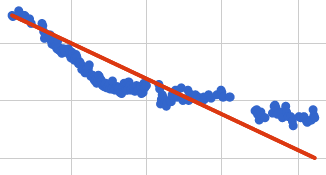
Tomorrow is my 47th birthday, which means today is the final day of my year-long weight-loss plan. Qualitatively it was a success! I look and feel better (and I sleep better at night). Most of my pants are now too loose. I can do pull-ups, which I previously could not, and I’m the lightest I’ve been in over seven years.

Quantitatively, though, I get a C-minus. I only made it 72% of the way toward my goal. I’m 9.6% lighter than I was one year ago; I was aiming for 13.4%. (On the other hand, if you measure from my heaviest point, which was less than one year ago, to my lightest point, which was a few days ago, I lost 10.8% of my body weight.)

As you can see from the graph, after an exciting fast start, losing weight was a stop-and-go proposition.

At Google, teams are encouraged to set measurable goals at the beginning of each quarter, and then to measure them at the end of each quarter. Scores of 100% are great, of course, but we’re taught that the ideal average score is actually around 70%. More than that and your goals aren’t ambitious enough. So maybe I should feel satisfied with my 72% (but I don’t).

My bathroom scale also measures body composition. According to that scale, my body-fat percentage went from “very high” to merely “high,” and my visceral fat number went from “high” to “normal.” My muscle-to-fat ratio climbed from 1.02 to 1.38. Gratifyingly, my “body age,” according to the scale, dropped from 56 to my actual age: 47.

My goal for the coming year is to lose another 10.2% of my weight. If I’m successful, my body-fat percentage will drop from “high” to “normal.” I’d also like to see my scale claim that my “body age” is lower than my actual age. Wish me luck…

The Sigma Tax

Pronounced income disparity is the root of many of our country’s problems. Economists have been talking about it for years, and last week President Obama made an attempt to bring the issue front-and-center in a speech at Knox College.

Another thing that economists have long said is, “When you tax something, you get less of it.” So here’s an idea: let’s tax income disparity!

How would this work? Easy. For companies of a given size, we decide what the ideal distribution is of wages and other compensation. We might decide, for instance, that the 90th percentile should be earning no more than 50x what the 10th percentile earns. Whatever numbers we choose, the result is a curve; presumably a less-pronounced one than this:

Once we decide on the shape of our curve, companies are free to obey it or not, distributing their compensation however they see fit. But if their curves deviate too far from the ideal, they pay a proportional income-disparity tax. Maybe they can even be eligible for an income-disparity credit if the curves deviate in the other direction.

Properly tuned, and phased in slowly, this “Sigma Tax” (for the Greek letter that designates standard deviation in statistics) should result in gentle but inexorable pressure that reduces the wage gap, improving things for the bottom 99% without breaking the 1%, while paring some of their shameful excess.

Practice makes perfect

Here’s something my kids have that I never did at their age: a belief in the value of practice for getting better at things.

When I was young, a number of things came easily to me. In particular, I excelled in school and earned a lot of praise with very little effort. Nice as that was, there was a downside: I had little patience for things I wasn’t naturally good at, like sports or dancing or playing piano. Even though I longed to be able to play music, and even though I made a few sincere starts at trying to learn, when I perceived the gulf between my ability and where I wanted to be I gave it up.

Of course I’ve always understood intellectually that training is how people get good at things, but I was well into adulthood before the reality of that fact managed to sink in — just in time to have a job, a dog, a wife, a house, two kids, and no free time to myself for practicing things. Just think of all the things I could be good at today if I had believed at a young age that it was possible to be!

Happily my kids don’t have that handicap. They’ve seen for themselves — with piano, parkour, martial arts, soccer, fencing, and more (not to mention reading, writing, and arithmetic) — that real progress comes with practice. The secret to teaching this lesson was to recognize even slight interest by the kids in a variety of activities, and once recognized, to compel their participation in those activities until they were over the “I can’t do it” hump. After that, quitting for other reasons was OK, like genuine loss of interest, or prioritizing another activity. But again and again it happened that slight interest turned into strong interest once the “I can do it” confidence began to flow.

Kids provoke the darnedest thoughts

A few days ago, as Archer and I were driving somewhere in the car, he asked me this question clear out of the blue: If you could live forever, what would you want to accomplish?

I have seldom heard a more profound question, and I told him so. After a moment’s thought, the answer that popped into my head — and from then until now, the only real answer that has occurred to me — was, “Help people use the Earth more responsibly.”

I do my part: I recycle, I drive a fuel-economical car, I vote in favor of open-space measures, I turn off lights, and so on. But that’s armchair environmentalism. Archer’s question, and my surprising reply, makes me think maybe it’s time to start doing more. I don’t expect to live forever, but I do hope my descendants will. Shouldn’t I act as if that’s the same thing?