Category Archives: science

Science limerick

Posted moments ago on Facebook in response to a challenge from They Might Be Giants for “science limericks”:

Is space made of strings or of foam?
Is it flat? Does it curve like a dome?
  Does time go both ways?
  Is the cosmos a phase?
I don’t know, but I still call it home

Kernel of truth

Yesterday I received a link — buried at the end of a long chain of e-mail forwards all saying variants of, “Wow, this is scary!” — to a video that depicted groups of people using stray microwaves from their cell phones to cause popcorn kernels to pop.

In the video, three or four phones are placed on a table in a ring around a few popcorn kernels, and then someone dials each of the phones to cause them to ring. Within a couple of seconds the kernels start to pop.

The sender who forwarded it to me asked if I knew whether this was for real.

My reply asked the sender to consider the power available to a cell phone versus the power available to a microwave oven. A microwave oven draws 15 amps of current from the household mains, producing hundreds of watts of focused microwave energy with the specific purpose of heating up food placed in the target area — and even so, it takes at least 30 seconds of exposure for the first kernel to pop. A cell phone, by contrast, houses a battery rated in milliamp-hours, with a typical one holding 1500 milliamp-hours of energy. This means it can draw 1 milliamp for 1500 hours, or 1500 milliamps (1.5 amps) for one hour, and so on. If a cell phone tried to draw 15 amps from such a battery, then (apart from the phone melting) the battery would be depleted in 1/10 of an hour — six minutes. Clearly cell phones do not draw 15 amps, but even if they did, they wouldn’t convert nearly as much of that energy into microwaves as microwave ovens do; and even if they did that, the microwave energy wouldn’t be focused the way it is in a microwave oven. Yet the video depicts the first kernel popping within about three seconds.

If that much microwave energy really were reaching the popcorn kernels, we’d also be seeing the other effects of powerful microwaves on objects in the immediate vicinity. For example, we’d see sparks and electrical arcing from metal objects, including the cell phones themselves. But we don’t.

Finally, why would a ringing cell phone cause popcorn to pop? To ring, a cell phone merely has to receive an “incoming-call” signal from a cell tower. The phone doesn’t begin transmitting any appreciable amount of power until after you answer it and begin speaking!

At this writing, the video in question has a supposed 11,031,929 views. When I think of all the people across the Internet who are now arranging their cell phones in rings around a handful of popcorn kernels, I despair.

Boy heaven

We did an amazing thing today.

As usual, Andrea had to drag me out of the house to it. I’m getting over a cold and all I wanted to do was catch up on blogging and work and Netflix discs, all of which sounded more interesting than driving to Point Reyes Station to see the culmination of the Giacomini Wetlands restoration project. But Andrea insisted, and I’m glad she did because she was right as usual, and it was amazing.

It’s a former marsh that was walled off from Pacific tides sixty years ago with a series of levees to create pastureland for cattle. Eight years ago the land was purchased by the National Park Service to begin a wetlands restoration project, which it turns out is a lot more complex than merely ripping out the levees. It’s taken from then until now for the project to reach its climax, which happened at high tide this morning. The public was invited to trek across the former ranch as water poured through a brand-new levee break and flooded the land for the first time in three generations.

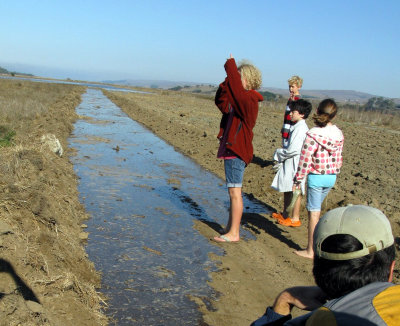
Turnout was huge. Hundreds of nature-lovers showed up on a crisp, picture-perfect autumn morning to walk across a vast flat range of grasses and overturned dusty soil where construction machinery had been hard at work. A shallow channel was dug into the ground, making a straight line for the open water that we could see on the horizon; and when we’d walked far enough across the pasture, we came to a spot where a trickle of water was turning the dusty channel bed damp. As we watched, fingers of mucky water reached inland, inch by inch.

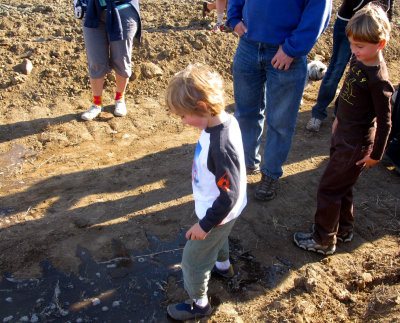
We stepped out of the channel onto the grass, which lay a few inches higher, as the water slowly overtook the spot where we’d been standing. Jonah and Archer tentatively placed their feet in the new muck.

A few minutes later they were notably less tentative.

All the grownups in the vicinity participated vicariously in Jonah’s and Archer’s delight at tromping through the mud, splashing in a dozen brand-new streams, pitching pebbles, ripping up tufts of grass, and conducting miniature impromptu soil-engineering projects. One onlooker commented to us, “Boy heaven.” (Lamentably, we saw almost no other children with anything approaching the liberty that we gave Jonah and Archer to explore and get absolutely filthy.)

Wherever we saw a limb of water, we could watch it reach into the low places in the land, rills of water filling one tiny depression after another. In some places the matted vegetation underfoot would grow first squishy and then splashy. Now and then a field mouse would emerge from a flooding hole and head for higher ground. Clods of dry soil would darken, crumble, then melt into thick dark mud through which Jonah and Archer gleefully trod. (We’re amazed it never sucked their shoes off.) Newly flooded sections of the plain bubbled noisily long after the last bit of earth was covered up.

When the tide began sluggishly to reverse itself, we retraced our steps through the pasture — at least, those parts of it that were still dry — returned to our cars, and reconvened a few miles down the road for a champagne celebration with the Park Service rangers and scientists for whom this was not merely an incredibly cool way to spend a Sunday morning. That it had been a lot of hard work was obvious, as was their satisfaction at its outcome.

Bullet time

I decided to apply a little physics to my KitchenAid mixer misadventure, in which I claim I was nearly killed by a hunk of metal propelled past my head by spinning mixer blades. When that projectile whizzed past my head, how much danger was I really in compared to, say, a bullet from a sniper’s rifle?

It comes down to a calculation of the kinetic energy of the projectile. Fortunately it’s very easy to approximate by making a few assumptions and by ignoring the effects of air resistance and the spray of cake batter.

The projectile was the mixer’s own removable endcap. As soon as it vibrated loose, fell into the bowl, and was struck by the spinning mixer blades, it was on a ballistic trajectory, arcing up, past my head, and then down behind me. Let’s assume that the highest point of the trajectory was about level with the top of my head, roughly 1.75 meters off the ground, and that this height was attained just as the projectile was passing me, meaning that once it did pass me, it had already started down.

We can decompose the motion of the projectile into a pair of vectors: the one pointing straight down to the floor and the one perpendicular to it, pointing horizontally past my head. The speed in that direction was constant until the endcap hit the floor. The speed in the floorward direction was increasing due to gravity.

Since we’ve assumed the endcap reached its apex as it passed my head, we know that its downward velocity at that moment was zero. We also know that the acceleration in that direction (due to gravity) is 9.8 meters per second per second. Finally we know from high school physics that:

distance = initial-velocity×time + acceleration×time2/2

and since we know initial-velocity is 0, we can rearrange this to say:

time = √distance/acceleration

And since we know “distance” is 1.75 meters and “acceleration” is 9.8 m/s2, we know that it took about 0.4 seconds for the endcap to fall from the height of my head, regardless of its motion in the horizontal direction.

In that 0.4 seconds I estimate (based on where I later found the endcap) that it covered a horizontal distance of 3 meters, giving it a speed of 7.5 meters per second.

I haven’t weighed the endcap but I’m going to guess it’s about 0.25 kilograms (around half a pound). Again, high school physics tells us that kinetic energy is:

mass×velocity2/2

which means the endcap, if aimed just a bit differently, would have struck me with about 7 joules of energy.

How bad would that have been, compared to a bullet? Apparently even the wimpiest guns deliver hundreds of joules to their targets, so we’re not looking at a shearing-off-the-top-of-my-head scenario here. On the other hand, I was there, and I’m not exaggerating when I say that hunk of metal could have dealt me a grievous injury at the very least. If that was what seven joules looks like, I have a whole new appreciation for the stopping power of a bullet.

How I wonder what you are

Often when I’m gazing at the night sky I will focus on a very dim star and marvel at its ability to shine steadily. No matter how long I look, and no matter whether I move a few inches to the left or right, it keeps right on shining. (It may twinkle a bit, but as you probably know, that’s due to our fluid, shifting atmosphere causing the starlight to refract slightly differently from one moment to the next, not due to anything about the star.) Photons emitted by that star hundreds of years ago poured out in such numbers that, even as they fanned out across unimaginable distances, there are still enough of them landing continuously in the tiny target of my eyes that the star remains a constant point of light.

Knowing the distances involved, it seems implausible that enough photons would be headed in my exact direction — of all the other places in the universe they could have gone! How implausible? Let’s figure it out.

We’ll start by estimating that the area of my dilated, night-sky-gazing pupils is about one square centimeter, or (to keep all measurements using the same units) one ten-thousandth of a square meter.

Thanks to Wikipedia I know that a single photon of visible light carries about 4×10-19 joules of energy which is just enough to excite a photoreceptor in my eye. How many must arrive each second for me to perceive a continuous image? I know that movies, projected at 24 frames per second, are good enough to trigger the persistence-of-vision effect. Since a distant star has far less detail than a frame of movie film, I’m guessing that it can appear steady at even fewer than 24 “frames” per second. Let’s guess 10 photons per second must arrive in my eyes to perceive a steadily shining star. 10 photons delivering 4×10-19 joules every second is 4×10-18 watts (because one watt is equal to one joule per second).

Now, how far is that star? A bit of googling reveals that a typical faintly visible star is 200 light years away (though many are much closer and many are much farther). 200 light years is 1.89×10¹⁸ meters.

From the perspective of that star, what fraction of its “sky” is taken up by my eyes? If you imagine a gigantic spherical shell centered on and surrounding that star, with a radius of 200 light years and my eyes on the inner surface, then the total area of that inner surface — the star’s “sky” — is 4×π×200light-years2, which is 503,000 square light-years, which is 4.5×1037 square meters. My pupils, one ten-thousandth of a square meter, comprise 1/2.22×1042 of that “sky.” That’s two millionths of a trillionth of a trillionth of a trillionth — not like that’s going to make my big ego feel small or anything.

So if 4×10-18 watts of visible light is delivered to 1/2.22×1042 of the star’s sky, then the total power delivered to its full sky is that first number divided by that second, which is 1.8×1024 watts, or 1.8 trillion terawatts. Is that a plausible number?

Yes it is. Our own sun has a visible-light output of 3.8×1026 watts. Which means, incidentally, that (using my guesses from above) it would be visible as a steadily shining star to a distance of 2.7×10¹⁹ meters, or about 2,900 light-years. Future criminals exiled from our galaxy will lose sight of their home star while barely a thousandth of the way to their new home in Andromeda.

U.S. Department of Mwa Ha Ha

From time to time in the popular science press I see something about generating electricity by placing enormous solar collectors in space and beaming the power as microwaves to special receivers on earth.

One such article, “‘Drilling Up’ — Some Look to Space for Energy,” appeared recently from the Associated Press. It describes a joint effort between the U.S. Department of Defense and the island nation of Palau to demonstrate the feasibility of receiving power from an orbiting satellite. The satellite will collect solar energy during its ninety-minute orbit, storing it up in order to beam it down to a receiver on Palau as it passes overhead. It will send a million watts of power during a five-minute window.

The article touts it as a forward-thinking alternative-energy project that will benefit at first the citizens of Palau and later the world. But nowhere in the article, or indeed in other articles of this ilk, are any red flags raised about placing in the Pentagon’s hands a solar death ray that can incinerate targets from orbit.

Now I don’t wish to impugn the Pentagon’s motives. I am sure their ambitions have everything to do with altruistically improving the standard of living for every person on earth and nothing to do with a lust for high-tech war toys. But if you or I built something that could store up three hundred million joules of energy and then deliver it all in a five-minute burst to any spot on earth, you could forgive the people of the world harboring a little concern.

You’d think that science writers could follow the technological implications of the things they write about. Hell, for this story all they need to do is watch some James Bond.


From Die Another Day

What brings you here, 2007 edition

Here are some of the top queries from various search engines that resulted in hits on my blog during the past year or so, reproduced verbatim from my server logs. (Last year’s results are here.) Each related family of queries is listed with a main variant in bold and selected other variants, plus the percentage of query-hits represented by that family.

I was at first surprised to see that hits for “James Bond villains” outnumbers hits for “vampire lesbian girl scouts” (etc.) and “sex” (etc.) combined, but then realized: the percentages are a function both of the popularity of that search and of the ranking of my site in the search results. In other words, if you’re looking for anything about vampires or lesbians or sex I regret to say there are a lot of likelier websites for you to visit before mine.

James Bond villains; The Villains of bond; deformed bond villains; “james bond” +villains +clothes 10.2%
William H. Macy; william h macy photos; face de William H. Macy 5.0%
Vampire lesbian girl scouts; lesbian vampires; naked lesbians; lesbian girl scouts; naked girl scouts; kissing lesbian girls; zombie girl scouts; evil girlscouts; girl scout decorated cake 4.5%
Sex etc.; horsey style sex; lesbian masturbation; “sex positions illustrated”; vampire sex; lesbians having hot lesbian sex; lesbian sex soundeffect; “San Francisco Masturbate-a-thon”; squat girl masturbate -cock -man -boy -blow; dildo attached to wall; sex positions kitty style; attach dildo to floor; How to convince my lady staf for sex?; sex positions in alphanumeric; “park and ride” “sex positions illustrated” 3.2%
Jaws ride; Jaws ride construction; jaws hitchcock 3.1%
e to the i pi plus one; pi relation to e; mathematical constant e Euler comic; relating pi, e, 1 and 0; “amazing relationship” e pi 2.3%
Don Fanucci; vito corleone fanucci 2.3%
Honeybee/Bees in chimney; humming sound when close glass fireplace doors; honeybees in chimney; bees in fireplace; bees chimney flying down 2.2%
Star Wars; 5th august 1977; star wars remake; hoth rebel base; “your tauntaun will freeze”; exegesis “empire strikes back”; star wars ben kenobi ghost; was obi wan strong enough to defeat palpatine; In Episode 5 what is the insult of Leia to Han Solo which Chewie laughed that Han called him “fuzzball” ?; lego star wars millennium falcon; star wars cassette tape 1977; “bob glickstein” “star wars”; mark hamill car crash empire strikes back monster; han solo slices open tauntaun quote; HOW DID THE FREAKIN EMPIRE BEGIN?!!!!!!!!!!!!!!!!!!!!!!!!!!; August+5th+1977; star wars novelization 1977; What does yoda say when luke comments that he is not afraid; why didn’t Luke kill the Wampa; “asteroid field”+”star wars”; star wars allegories; star wars 1970 nerd; “time magazine” 1977 “star wars” 2.1%
Pirates of the Caribbean; pirate medallion; does elizabeth swann love jack sparrow; elizabeth swann’s red dress; jack sparrow character motivation 2.1%
Widescreen viewing area; “what size tv to buy”; “square inches” diagonal widescreen chart; determine tv width given diagonal; 42″ 16:9 square inches; 16:9 4:3 screen equivalence OR correspondance; DIAGONAL ASPECT RATIO FORMULA; pythagoras 16:9 screen size 32″ 1.8%
Godfather; Godfather part II poster; Godfather Part 4: Fredo’s Revenge 1.8%
Susan Oliver/Orion Slave Girl; vina star trek; star trek green orion slave; nude Orion slave girl; orion slave girls makeup; orion slave girls color correction 1.7%
Cathy Lee Crosby/Wonder Woman; cathy lee crosby wonderwoman film download; cathy+lee+crosby+as+wonder+woman; wonder woman drag; WONDERWOMAN TV MOVIE 1.7%
Rogaine; scalp conditions; itchy scalp; rogaine results; scalp exercise; rogaine effectiveness 1.7%
Ursula sex; ursula undress; ursula dildo; ursula sex disney 1.6%
Comcast; comcast removes channels; comcast turn off service; comcast losing west coast feeds; complaints over comcast hbo; disable speed reduction comcast cable; compression artifacts comcast; how do i delete channels i do not watch in comcast; comcast crappy broadcast; comcast reduction in service; do i get a rate reduction when comcast removes channels; I want both west coast and east coast feeds 1.6%
Bob Glickstein; gee bobg; “bob glickstein” +yoga; bob glickstein andrea; bob glickstein imdb; growing up Glickstein 1.4%
Trophy; ugly trophy; dna trophy; bezos trophy 1.3%
Dog; how to draw dogs; “remington dog park”; dog pee drives away evil spirits; veterinary dogs and chocolate 1.3%
Lulav; lulav and etrog; big picture of a lulav and etrog; lulav by its self; lulav etrog chabad; sukkot lulav without etrog 1.3%
Star Trek/Enterprise/Kirk/etc.; spock uhura; Uhura uniform; 60 star trek uniform; bonk bonk on the head star trek; Captain Kirk’s Insignia; enterprise blueprints; happy birthday star trek; Klingons-Star Trek; Atheist Star Trek; 1.2%
Amy Linker; what happened to amy linker; amy linker and tv land awards 1.1%
Jodie Foster; jodie foster bugsy malone; YOUNG JODIE FOSTER; +”give a little love and it all comes back to you” +foster 1.1%
Joseph Costanzo; joe costanzo restaurant; Joseph costanzo primadonna 1.1%
The end of Superman; superman reverse time; superman in the end; superman earth spinning; can superman go the speed of light; how many times can superman fly around earth in 1 second; +”it is forbidden for you to interfere in human history”; superman rewind time; how many times does superman fly around the earth in order to reverse its rotation 1.0%
Frank Pentangeli; frank pentangeli hit; roth corleone Frank Pentangeli assassination; frank pentangeli johnny ola 1.0%
Thai gem scam; thailand scam; majestic export jewelry thailand scam; gems profit thailand; thai sapphire scam; thailand conman; buying gemstones, thailand, blog; thai Export Center scam; selling thai gems; what to do if conned in thailand; david maurer thailand 1.0%
Evil cats 0.8%
Food photography; food stylist; food styling “pasta”; food stylists cereal; food stylist burger; tricks of a food stylist 0.8%
Each daughter has the same number…; In a certain family each daughter has the same number of brothers and sisters. Each son has twice as many sisters as brothers. How many sons and daughters are there in the family? Now there are two ways to do this obviously, you can do it the hard way or the easy way. 0.8%
Fizzies; what ever happened to fizzies drink tablets; how do fizzies work; fizzies that are new; Fizzie tablet sex aid; truckload of fizzies; FIZZIES FOUNTAIN 0.7%
James Bond; vintage james bond girls; james bond toys; the bond men; Live and Let Die Band James Bond 0.7%
Pez museum; pez incredibles violet; batman pez dispensers; pez guns; why didnt violet parr become a pez machine; headless PEZ dispensers 0.7%
Vincent Price; old photos of Vincent Price; Vincent Price gay; “the saint” vincent price; 0.5%
Candy; old time candy; “dylan’s candy bar”; Candy of yesteryear 0.5%
Entenmann’s; golden cake; entenmanns’ chocolate chip filled crumb cake recipe; entenmann fudge golden cake 0.5%
Adam Stoller; why i owe adam stoller an apology; fish adam stoller 0.5%
MoveOn; moveon.org bad; moveon.org founder; move away from moveon.org; moveon endorsements nov 2007 election 0.5%
Vertical speed indicator/Altimeter; static port; instrument dial Concorde speed; how does an altimeter work; pitot static instruments; ram air pressure pitot; how does the vsi work? flying 0.5%
Cigarettes/Camels/Still Life With Woodpecker; Joe Camel; tom robbins woodpecker; camel tom robbins 0.5%
Baron Munchausen; was baron munchausen an atheist 0.5%
Sharon Stone; sharon stone naked; sharon stone’ pictures, 1970; sharon stone en lingerie fine 0.5%
Computer; computers internet blog; “apple II home computer” 0.4%
xkcd; xkcd complex numbers; calculus xkcd; math xkcd 0.4%
Bob Falfa/Martin Stett; big bob falfa; purchase a bob falfa hat; falfa and milner 0.4%
Adrift/Open Water 2; “open water 2″ true story tried everything; understand explain open water 2:adrift ending?; FORGOT TO LOWER LADDER ON YACHT 0.4%
Honda Fit; finding a honda fit; pre order “honda fit” bay area; vw rabbit or honda fit? 0.4%
Carl Sagan; “carl sagan” +billions; cosmos carl sagan vangelis heaven hell; “circumference of the earth” carl sagan; eratosthenes carl sagan; Carl Sagan and Star Trek 0.4%
Splashdown; splashdown lyrics meaning; i feel so elated would you please bring me joy lyrics; free splashdown downloads karma slave; lyrics so if your past approaches you pulled into a war you’ll lose; karma slave splashdown video; i feel so elated i do i do splashdown 0.4%
The Incredibles; Life Lessons The Incredibles; incredibles analogy of family togetherness 0.3%
Legobiggest lego city ever made; Cool lego creations; LEGO WORLD RECORD FOR MILLENIUM FALCON 0.3%
Birthday invitation; neverland invitation 0.3%
Mill Valley Pediatrics; what new rule causes pediatrician to close office; dr. Harris pediatrics mill valley 0.3%
BDSM; BDSM and rodent; hellium balloons bdsm; bdsm “trembling with fear”; professional bdsm pittsburgh; bdsm vanity plates 0.3%
Richard S. Castellano 0.3%
Bugsy Malone/Scott Baio; coca cola jingle+you give a little love and all comes back to you 0.3%
Games magazine/Calculatrivia marathon; ken jennings calculatrivia; “games magazine” contest t-shirt 0.3%
Penis; Jonah Falcon penis; christmas penis drawing; penis peeing pictures; penis doodles; “draw a penis” 0.3%
Drawing/scribbling/doodling; kids scribbles 0.3%
Raiders of the Lost Ark; indiana jones medallion + raiders of the lost ark; indiana jones finds millenium falcon; indiana jones harrison ford sean connery 0.3%
I know it was you Fredo.; Johnny Ola Fredo; HOW DOES MICHAEL KNOW ABOUT FREDO; +”why” +michael +kill +fredo 0.3%
Federation Trading Post 0.2%
Funny epitaph; headstone humor; headstone for mom 0.2%
Batman; shark repellent spray; batman and the shark; batman robin “more toyetic” 0.2%
Handshadow; Hand-Shadow play 0.2%
Peter and the Starcatchers 0.2%
Watch neighbor undress; neighbor undress photo 0.2%
Lemon Ice King of Corona; queens ices 0.2%
Weight; weight graph; college freshman weight graph; jewish weight loss 0.2%
Marty Goldstein/Black Book; ‘marty goldstein’ ‘creative black book’; i remember going to the black book office zanetti 0.2%
Kinds of meat; meatballs three kinds of meat 0.2%
Fligth to Mars 0.2%
Supertanker; how much does a supertanker cost?; how many barrels of oil does a supertanker carry; how much money does a supertanker captain make; running costs for a supertanker; becoming a supertanker captain; supertankers are curved 0.2%
Jewish; jew obnoxious; jewish products; mormon jew; mountain jew; val kilmer sephardic jewish 0.2%
Cartelligent; Leigh Taylor, Cartelligent; cartelligent price for honda fit 0.2%
Sweetener; hooray sweetener; cyclamates popularity sodas; Is Cyclamates good for you; sodium bicarbonate sweetener cancer 0.2%
Captain Morgan rum 0.2%
Gerald Zanetti 0.2%
Bush smile 0.2%
Salt Lake flats; nevada open salt lake 0.2%
Disney; disney+AND+fingerprint; disney park hopper fingerprint; thumper disney 0.2%
Koyaanisqatsi 0.2%
Katharine Hepburn 0.2%
Incremental backup; jungledisk incremental backups; s3 backup incremental mirror linux; simple linux incremental backups; infinite backup 0.2%
Rhymes with Bethany; bethany accident utah; something that rhymes with bethany; poem for bethany 0.1%
Sci-fi spaceships; cool Scifi Spaceships; most beautiful spaceships 0.1%
I Dream of Jeannie; healey irresistible to when i dream of jeannie episode; i dream of jeanie colorization 0.1%
Laundry; how to get quarters laundry; cold undissolved laundry soap; monopolize laundry machines; laundry pile 0.1%
Anakin/Padme; How much do Anakin’s talent, pride and ambitions affect his decisions to turn to ‘the dark side’? 0.1%
Making Mr. Right; malkovich “making mr right” 0.1%
Pop-culture grid; “the pop culture grid”+last concert you saw 0.1%
Adventurer’s Inn; toboggan adventurer’s inn 0.1%
Clemenza; young clemenza; who killed clemenza 0.1%
Glenne Headley 0.1%
1776/“Yours Yours Yours” 0.1%
Nature of reality; 10 dimensions of reality; how to understand ten dimensional reality; three-dimensional pants 0.1%
Dunk tank; “spring carnival” dunk 0.1%
Misconstruction 0.1%
Sarah Jessica Parker; sarah jessica parker in square pegs 0.1%
Mr. Arrigo; Robert arrigo teacher 0.1%
Eli Attie 0.1%
Hog-calling time in Nebraska; What tune is hog calling time in nebraska sung to?; ORIGINS OF HOG CALLING; hog calling songs 0.1%
Eulogy for a friend 0.1%
Indiana University; indiana university hofstadter 0.1%
Cynthia Nixon; Cynthia Nixon manhattan project 0.1%
Pine Knoll Bungalow Colony; bungalow colonies in monticello 0.1%
Prison Break; prisoner 94941; michael scofield myer briggs; “prisoner number” scofield 0.1%
Winnemucca, NV; Winnemucca weekly pet friendly motels; reasons to love Winnemucca, NV 0.1%
Steve Volan 0.1%
P.S. 196; all teachers from p.s.196 0.1%
Knish Nosh; knish nosh health department 0.1%
Mucoshave 0.1%
Laser/Theodore Maiman; 1966 national geographic “the laser’s bright magic”; what kind of food does theodore maiman likes; did theodore maiman get alot of money for making the laser 0.1%
Jeff Bezos; BEZOS THE GREATEST 0.1%
Universal Hall Pass 0.1%

The beginning of wisdom

[This post is participating in Strange Culture's Film + Faith Blog-a-thon. Warning: spoilers follow for the book and film Contact. Update 16 Dec: this post is also participating in Joel Schlosberg's second annual Carl Sagan Memorial Blog-a-thon.]

I read Carl Sagan‘s novel, Contact, soon after it was published in the late 1980′s, and enjoyed it greatly. It’s the story of a radio astronomer, Ellie Arroway, who is the first person on Earth to detect, verify, and begin deciphering a genuine extraterrestrial message.

A considerable part of the story is devoted to the societal implications of Arroway’s discovery, especially among various religious communities. As it’s depicted in the book, Ellie must suffer various crackpots, blowhards, and garden-variety religious leaders (well-meaning but deluded) spouting their superstitious blather in her quest to secure the resources needed to finish decoding the alien transmission and build the Great Machine.

For the transmission includes, among other things, construction plans for a tremendous and tremendously complicated machine. At its center is a capsule that seats five intrepid adventurers. No one knows what will happen when the machine is switched on. Will the capsule launch into space? Travel through time? Pop into a different dimension? Or is it a weapon that will obliterate the Earth?

The trials involved in achieving the goal of building and activating the Machine are portrayed very much as the power of pure reason overcoming the fetters of fear and ignorance. In the end, Ellie and her fellow travelers are propelled across vast distances and have a surprising encounter with a superior but benevolent race. When they return days later, they discover that no time has elapsed on Earth, leaving a diehard core of doubters free to insist that nothing at all happened, even though there is compelling evidence to support the stories told by Ellie and the others. Science is the clear winner, religion the loser, and it’s pure wish fulfillment: what atheist hasn’t dreamed of winning one of those unwinnable arguments about faith and science against a true believer?

In Robert Zemeckis’ film version of Contact, things are subtly different. Ellie is as much an empiricist as in the book, but man-of-God Palmer Joss is much less easy to dismiss out of hand. His interplay with Ellie on the subject of faith leaves her uncharacteristically at a loss, unable to turn him aside by articulating the bedrock principles of skeptical inquiry.

When the time comes to try the Machine, crucially there is room in it for only one person, so that when Ellie returns from her amazing journey there is no one to corroborate her account. There is also a total absence of physical evidence to support her story. Ellie ends up passionately, desperately trying to persuade people to believe what she is certain is true but cannot prove. Palmer Joss sympathetically points out that this is precisely the situation in which persons of faith find themselves.

It’s a marvelous storytelling contrivance, and the dialogue and performances drive the point home economically and convincingly. But I left the theater conflicted. On the one hand, the film had excellent performances and astonishing visuals, it was exhilarating to see an intelligent, uncliched portrayal of science and scientists in a mainstream Hollywood movie, and it was in many respects faithful to the novel. Where changes were made, by and large they were to add some emotional depth that had been missing from Sagan’s plot- and technology-heavy writing. On the other hand, the rebalancing of science and religion changed what the story was fundamentally about! It offended me that Carl Sagan, recently deceased after a lifetime of science advocacy (today would have been his 73rd birthday, by the way), should have his fantasy about the triumph of humanism and reason watered down for a mass audience!

Over time, though, the film version grew on me and I recognized it as something greater than the source novel: an adventure in which reason triumphs and an exploration of the tangled interrelationship between belief and skepticism. Where I had been hoping to see religious moviegoers get schooled in the virtues of rational thought, instead I had received a lesson about the nuances and complexities of the human experience. The science-beats-religion version of the story had become, to me, overly simplistic. (Sorry, Carl.)

After all, even Mr. Spock admits, near the end of a long career working with humans, that “logic is the beginning of wisdom, not the end.”

Save the world with Admiral Bob

Recently I read a NewScientist article about changes in rainfall patterns due to global warming, and it predicted the usual depressing outcomes in the medium to long term: famine, disease, war, immense human suffering.

Then three thoughts occurred to me: 1) a very large amount of the world’s freshwater is lost in the form of rain that falls at sea; 2) meanwhile, enormous petroleum supertankers ply those very same seas; 3) in some places, people pay more per liter for bottled water than they do for gasoline.

These thoughts were synthesized into a pretty freakin’ awesome idea: deploy a fleet of supertankers harvesting rainwater. They would use weather radar to hunt the heaviest precipitation (and the stormiest seas, like as not — only the hardiest sailors need apply). Any rain falling on their decks could be funneled straight into the holding tanks. I’m not sure how you’d keep seawater out of the tanks, as waves would frequently break over the deck of the ship in stormy seas, but that seems like a surmountable engineering detail.

Does it make economic sense to harvest rainwater this way? Let’s start by assuming it’s economical to transport petroleum by supertanker. (A safe assumption.) The retail price of a gallon of gasoline here in Northern California is presently right around three dollars. I don’t know how much crude oil goes into a gallon of gasoline, but for our very rough calculations it’s simplest and safe to say a gallon of gasoline equals a gallon of crude.

That three dollars per gallon we pay at the pump has to cover a lot of oil-industry expenses that a freshwater industry would not have: refineries, research, exploration, and drilling, not to mention giant slush funds for dealing with corrupt foreign regimes. And oil-industry tankers must be double-hulled to protect against spills. Freshwater tankers can be single-hulled.

On the other hand, whereas the oil industry can use their supertankers simply to transport millions of barrels of oil from one place directly to another, a freshwater fleet would have to roam at sea for a while until it contained enough water to make a delivery. This is an operational expense the oil industry does not have. How long must a freshwater supertanker follow rainstorms around until it is full? According to Wikipedia, a supertanker named the TI Asia has a depth (height) of 112 feet. Let’s guess that the tanks it contains are 60 feet high. For simplicity, let’s further assume these tanks have a uniform width — they don’t taper at the bottom or anything like that. This means that the ship must collect 60 feet of rain to fill its tanks — possibly less if a catch area much wider than the tanks themselves can be funneled into them. How long would it take to collect that much rain, if you’re always steering into the heaviest rainfall? Let’s guess that a good freshwater supertanker captain can expect an average of four inches of rain per day. That’s six months at sea to fill the freshwater tanks.

How much does it cost to have a supertanker crisscrossing the bounding main for six months? I have no idea, but let’s keep guessing and say that that cost roughly offsets the petroleum-industry-only costs I listed above (drilling, bribes, etc). This means that the fleet could deliver freshwater for about three dollars per gallon, which is about 79 cents per liter, which is very reasonable compared to the prices paid per liter of bottled water in many places threatened by future global-warming droughts.

The TI Asia can carry half a billion gallons of oil. If a comparable freshwater supertanker can carry an equal volume of water (which is not certain, since water is heavier than oil), then it can deliver a year’s worth of drinking water for a million people. Half a billion gallons is also equal to 1,534 acre-feet, enough water to irrigate 736 acres of crops for a year, but that sounds much less impressive, and at a cost of almost a million dollars per acre-foot, it’s nowhere near competitive.

Would I like to be the admiral of a fleet of freshwater supertankers saving the world? Hell yeah. For many weeks after this idea came to me, I kept it to myself. But then I looked at my pile of ideas-to-implement-someday, and the large subset of those that are in the category no-idea-how-to-get-started (which includes this one), and decided the world needs this idea more than I do. So, one of you reading this: get started. Just do me a favor and christen the first ship the gee bobg.