In 1996, three friends and I left our jobs at Z-Code Software (which by then had been acquired by NCD, which is a whole story in itself) to found our own e-mail software company, Zanshin. To get the company going, we each put in ten thousand dollars of our own money.
Zanshin
Zanshin is a Japanese word relating to follow-through (particularly in the martial arts), but it has other nice connotations too. We chose it after reading this passage in Neal Stephenson‘s Snow Crash:
The businessman turns out to have a lot of zanshin. Translating this concept into English is like translating “fuckface” into Nipponese, but it might translate into “emotional intensity” in football lingo. […] “Emotional intensity” doesn’t convey the half of it, of course. It is the kind of coarse and disappointing translation that makes the dismembered bodies of samurai warriors spin in their graves. The word “zanshin” is larded down with a lot of other folderol that you have to be Nipponese to understand.
Zanshin (the company) still exists, though I’m no longer involved day-to-day, it’s in a completely different business from the one we started, and it now operates under the name iPost.
Sitting down with our lawyer to draw up the paperwork for the new corporation, he asked us what the ownership structure of the company was. We replied that we were four equal partners. He next asked how many shares of company stock we wanted to issue.
We looked at each other and shrugged. We were all novices at this. “Uh, I dunno,” we muttered in various forms. I ventured:
“Four?”
The lawyer looked at me as if I’d just suggested we eat the table for lunch. “No,” he said with a smile, as if getting my joke.
But I was sincere. “Why not?” I asked.
“Because each share would then cost ten thousand dollars.”
“So?”
“So, what if you want to accept investment in something other than multiples of ten thousand dollars? To make the shares worth twenty dollars each, we’d have to do a 500-for-1 stock split!”
“So?” The mathematician in me was kicking in and I wasn’t letting it drop. “If we want to accept outside investment there’ll be stock-related paperwork anyway, so why not also do a 500-for-1 split at that time?”
“Well, it’s just not what new companies do,” he said. I protested a couple more times — one share apiece was both necessary and sufficient, any other number would be arbitrary — and he countered. He seemed as sure that I was nuts as I was about him — though only I could articulate my side of the debate, his obviously consisted of nothing but inertia from decades of unquestioned acquiescence in tradition. My partners were beginning to roll their eyes, the lawyer was growing uncomfortable (and costing us money!), and I was aware I didn’t know everything about starting companies, so finally I let it drop. On the lawyer’s advice we issued 800,000 shares in the new company, each worth a nickel, and we each got 200,000 of them.
Trivial though the matter was, to this day it bothers me that I caved. You might say that makes me stubborn. I call it a healthy mistrust of authority.
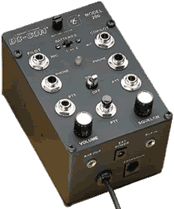 Flustered, I explained to the instructor that this was my first time using a two-person intercom with the radio stack. (In small planes, very often the intercom is a separate little box that the pilot owns. Two headsets plug into it, then the box — which usually ends up wedged between the front seats or knocking around loose on the floor of the cabin — plugs into the radio. Before the checkride, I flew solo with no need for an intercom — my headset plugged right into the radio — and before flying solo, my instructor would always set up his intercom for us to use.) The examiner put me at ease, saying, “Anyone could have forgotten to plug in the intercom. It’s not on the checklist. A poor student would have given up and started taxiing without clearance. You did what you were supposed to do, even if it took a little longer.”
 All of which was interesting enough to think about that it prompted me to begin writing this blog post, which in turn prompted me to look up
  To my surprise, nearly all of the cast had zero, one, or two additional film credits after Bugsy Malone, and that’s all. Scott Baio played the title role, and he of course enjoyed
 …where I found aluminum catering trays full of white rice and Chinese vegetables, left over from someone’s lunch meeting. I heaped some on a plate and headed for the stairwell back to my desk. On the way there I encountered my coworker Cid, who asked me, “Do you eat meat?” “